I mean, all games, especially the open-world ones, operate on the player’s free will, right?
Well, yes. But in stepping into Jin Sakai’s shoes and roaming 13th-century Japan, you take on more than just the role of a hero liberating Tsushima from foreign invaders.
In fact, Ghost of Tsushima is a virtual microcosm where you get to stretch your moral compass. And kudos to Sucker Punch for crafting a world where you can integrate free will and uncover the underpinnings of human growth or decadence, for that matter.
Place Morals on a Spectrum
Jin’s first taste of the caveats of samurai honor happened on the bloody night at Komoda Beach. 80 samurai sauntered to go toe-to-toe with the Mongol invaders, meeting their sticky ends in the name of tradition and glory.
Learning that their enemies studied the way of the samurai meticulously to immerse themselves in Japanese culture and hijack it with their own, he knew he had to set aside his moral code and win by other means.
You know what they say: if you can’t beat them, join them.
Of course, Jin didn’t literally join the Mongols and betray his people. Instead, he placed his samurai code on a spectrum and bent some aspects to fit his goals.
His first stealth kill proved to be gut-churning for him, due to his warrior-class upbringing. But by reminding himself that he is doing this to get back at the enemy, his resolve to win, despite abandoning everything he was taught, became stronger.
In real life, this reflects how free will plays into moral development. As people mature cognitively, they begin reasoning based on social contracts, fairness, principles, and context.
At higher stages, morality becomes less about rules and more about values, nuance, and competing obligations. In a nutshell, this is where the gray starts to appear.
Wear It Like You Mean It
The wardrobe change is one of the most fun functions of Ghost of Tsushima. I remember the thrill of finally changing out of Jin’s tattered samurai armor into a range of complete and polished battle gear and ancient Japanese ensembles.
Like many action-adventure games, clothing is usually equipped with buffs and stats that players can use to create a build that suits their play style.
For instance, Jin has armor sets that could increase his health and defense, as well as garments that make him harder to detect while hiding in grass, at least.
His closet is also a playground for players to embody either the samurai way or the Ghost persona. For example, donning the fully refined Sakai Clan armor lets the player live the samurai life through Jin vicariously.
On the other hand, the more dressed-down yet still elegant Kensei armor set gives off a sense of excellent sword mastery—the kind that makes your enemies run because you don’t need full metal plates to stay alive.
This aligns with the concept of enclothed cognition, or the idea that how you dress shapes how you behave and how you perceive yourself.
And in the case of players, some would dress up Jin with the most ridiculous outfit combinations just for laughs and still beat enemies like they were born to be warriors of that time.
Others would carefully curate the right headgear, top, and bottom to suit their fashion tastes and chosen fighting style.
Whether for embodiment or for avant-garde purposes, the game exemplifies the human condition of wearing what they like, what makes them feel better about themselves, and what reflects their inner self.
Change the Weather to Make Yourself Feel Better
If there’s one thing Ghost of Tsushima understands deeply, it’s mood. Not just the player’s mood, but Jin’s.
The dynamic weather system is not random eye candy. Storms brew more frequently the more you lean into the Ghost persona. Clear skies favor the honorable samurai path. The island itself responds to your moral tilt, as if nature is quietly judging your choices.
And then there’s the flute.
With a simple swipe on the touchpad, Jin can play a melody and summon sunlight, fog, or rain.
It’s a subtle mechanic, but psychologically, it’s powerful. You’re not just reacting to the environment—you’re regulating it.
And this is the closest you’ll get to emotional regulation digitally.
In real life, we cannot summon a gentle breeze when we’re stressed. We cannot push away a storm with a melody.
But we do try to influence our environments in small, controllable ways. We change the lighting. We put on music. We take a walk. We curate the atmosphere to match or shift our inner state.
Ghost of Tsushima gives you that power overtly.
Had a rough duel? Play a calming tune and let golden sunlight wash over the pampas grass. Going stealth in a Mongol camp? Call down fog and let the world shrink into something quieter and more manageable.
It’s control in a world built on chaos.
There’s something almost meditative about it. Between missions, I found myself riding aimlessly, letting the wind guide me, adjusting the skies not because I needed tactical advantage but because it felt right.
Like catching the rhythm of a GZone tour tongits match—strategic, unpredictable, and surprisingly satisfying when you get it just right.
That mechanic taps into something very human: the need to feel agency.
When life feels unpredictable, even symbolic control can restore a sense of balance. Changing the weather in-game becomes less about strategy and more about psychological recalibration.
And perhaps that’s the quiet brilliance of it. The game never lectures you about emotional awareness. It simply lets you play a song and watch the storm recede—and sometimes, that’s enough.
Or Change the Difficulty to Win
Now, let’s talk about pride—and maybe a little bit of honor.
Ghost of Tsushima offers multiple difficulty settings, from forgiving to punishing. On higher levels, enemies are sharper, faster, and less tolerant of your mistakes.
Duels feel lethal, as a single misread can cost you the fight.
On lower settings, you can still enjoy the story without being shredded by every spear-wielding Mongol you encounter.
Now here’s the psychological crux: Is lowering the difficulty a moral failure?
Gamers love to pretend it is. There’s this unspoken hierarchy that equates suffering with authenticity. If you didn’t bleed for it, did you even earn it?
But that mindset mirrors a broader human fallacy.
We often equate hardship with virtue. Struggle with worth. Pain with legitimacy.
Yet adjusting difficulty is simply calibrating the challenge to skill. It’s recognizing your current limits and deciding how you want to experience the journey.
That, too, is free will.
Some players crave the razor’s edge of Lethal Mode. They want every duel to feel like Komoda Beach all over again. Others want to absorb the narrative, the music, and the wind-swept fields without fighting the same boss twelve times.
But note that neither is morally superior.
In psychology, this ties to the concept of optimal challenge. We grow best when tasks are neither too easy nor impossibly hard. The sweet spot fosters engagement and mastery.
Changing difficulty is not cheating the system. It’s customizing growth.
And perhaps that circles back to the moral spectrum discussed earlier. Just as Jin bends the samurai code to survive, players bend the rules of engagement to shape their experience.
More importantly, rigid adherence to “hard mode or nothing” is just another form of moral absolutism.
Flexibility, when grounded in intention, is maturity.
Final Thoughts
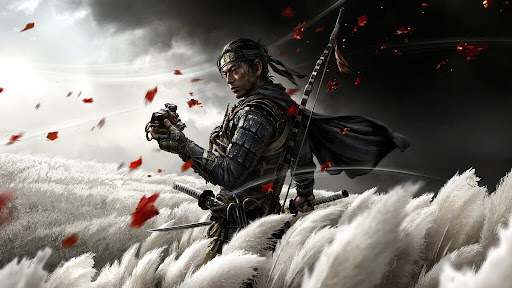
Ghost of Tsushima is not just a samurai power fantasy wrapped in stunning visuals. It is a study in agency and a deep dive into how humans adjust their principles for certain circumstances.
From bending moral codes to adjusting wardrobes, summoning storms, and recalibrating difficulty, every mechanic reinforces a central truth: freedom is layered.
You are free to uphold tradition or abandon it. Free to dress like a disciplined clan heir or a wandering swordsman. Free to call the sun or the rain. Free to struggle through brutal duels or tailor the fight to your skill level.
And in each decision, the game quietly mirrors real life.
Morality is rarely binary. Identity is rarely fixed. Growth often demands discomfort, but wisdom demands discernment.
Jin Sakai’s journey across Tsushima is not just about defeating invaders. It is about negotiating who he must become to protect what he loves.
In that sense, Ghost of Tsushima does something rare. It hands you the blade, the flute, the armor, and the storm. But what you do with them is entirely up to you.