Let’s get the good part out of the way first. The CSGOEmpire Promo Code “CSGOBETTINGS” hands new accounts a free case with bonus coins, and the reward can climb to $1,500 in value. You type “CSGOBETTINGS” when you register on CSGOEmpire, open the case, and that’s your starting bankroll for Case Battles, Coinflip, or Roulette. You only get to redeem it once per new account, but the daily coins and the experience based bonus cases keep things rolling after that. Just remember it’s 18+ only, gambling can become a genuine problem for some people, and you should never put in more than you’d be fine losing.
A quick note on the CSGOEmpire codes
People overthink this part. “CSGOBETTINGS” doubles as a CSGOEmpire promo code and a CSGOEmpire referral code at the same time. One string, redeemed once, one free case. You’ll find plenty of other CSGOEmpire codes posted on forums and YouTube, but almost all of them lead to the same reward, so chasing the “best” CSGOEmpire promocode is mostly wasted effort. Drop the CSGOEmpire free code in at sign up and you’re done.
Asking whether is CSGOEmpire legit? Fair question to have. It’s been around far longer than most skin sites, it logs you in through Steam rather than a separate password, and the games run on a provably fair system, with KYC kicking in on bigger crypto withdrawals. None of that is a guarantee, so read the terms yourself and treat the free case as something fun rather than an investment.
Right. Now the economy that actually decides your matches.
How CS2’s Economy Wins Rounds Before a Single Shot
Ask a new Counter-Strike 2 player what wins a match and you’ll hear about aim, crosshair placement, maybe a clutch spray transfer. Ask a pro and the answer is usually a lot less exciting. Money. The buy menu in CS2 is its own little battlefield, and teams who understand it beat opponents with cleaner mechanics all the time. This isn’t trivia for the curious. It’s the difference between walking into a round with a full kit and scraping together a pistol round you never wanted to play.
Where the money comes from
You open every match with $800, which is just enough to feel broke. From there the cash comes from a few places, and each one shapes how you should read the round.
Win a round and the whole team banks $3,250 each. Plant or defuse the bomb and that goes up to $3,500. Kills pay as well, though the figure swings with the weapon in your hands. A rifle kill is $300, pistols give $150, and the AWP, oddly enough, returns just $100. The real earners are SMGs at $600 a kill, which is the whole reason you’ll catch a smart player whipping out a MAC-10 on a thin buy. Grab two or three frags with it and you’ve basically paid for your next rifle.
One newer detail catches a lot of people off guard. A 2025 update to Counter-Strike 2 handed Counter-Terrorists a shared kill bonus, so any time a CT drops a Terrorist, every CT on the team picks up $50. Fifty dollars feels like pocket lint until you spread it across five players over several rounds, and suddenly the defending side has a real cushion. Those rounds where you barely scrape one exit kill sting a lot less now.
The loss bonus, or why losing isn’t game over
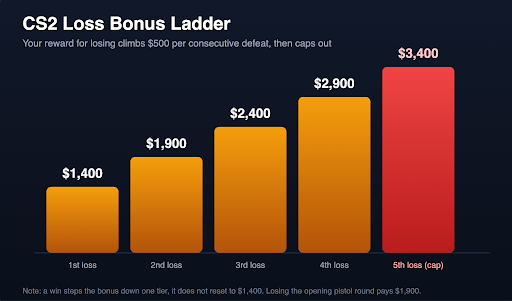
This is the mechanic that keeps Counter-Strike’s economy interesting instead of a snowball where the rich just get richer. When you lose, you still get paid through the loss bonus. It opens at $1,400 for your first defeat and adds $500 for every loss in a row, topping out at $3,400. Lose the very first pistol round and there’s a special payout of $1,900.
The whole thing is a built in safety net. A team that drops the pistol doesn’t get buried alive, and it makes room for one of the slyest plays in the game, the planned eco. If a full buy is out of reach anyway, you can choose to lose the round on the cheap. Keep your guns, spend next to nothing, let the bonus stack, and roll back in a couple of rounds later with rifles and a full bag of utility.
Here’s the bit that confuses newcomers. Winning doesn’t reset your loss bonus to zero. It only knocks it down by one step. So a team sitting on the full $3,400 that grabs a single round slides to the next tier, not all the way back to $1,400. Once you can eyeball where the enemy sits on that ladder, you basically know whether their next round is a real buy or a desperate gamble.
Reading the four buy types
When the income makes sense, every buy falls into one of four shapes, and the good teams call these out loud together instead of each player deciding on a whim.
A full buy is rifles, armor, and a complete grenade lineup. That’s your go to after a win, or any time the whole squad can afford it. A half buy means upgraded pistols, maybe a bit of armor and a grenade, while you hold back enough cash for the next round. A force buy is where you empty the wallet because the round demands it, usually right after a close one you reckon you can steal. Big risk, big payoff. An eco is the opposite, spending almost nothing so you can bank for a guaranteed strong round later.
There’s an unwritten rule that keeps most players out of money trouble. Try not to dip under roughly $2,000 on a half buy if you want a clean full buy next round. Cross that line too often and you’ll spend the entire match a step behind on gear.
Play their wallet, not just yours
The real edge shows up the moment you stop staring at your own balance and start tracking theirs. Pull up the scoreboard mid game and the enemy loss streak tells you roughly what they can afford. Think they’re on an eco? Push, take space, and deny them kill rewards. Smell a force buy? Slow it down, hold your angles, trade properly, and let their gamble fall apart on its own. Even a single smart save, where you keep your AWP alive instead of feeding it into a lost round, can flip the next two rounds your way.
The bottom line
This is what people mean when they say Counter-Strike is won before the first bullet flies. Aim still matters, obviously, and no amount of clever spending rescues you if you can’t hit your shots. But money management is the quiet skill that builds up over a match. The team that spends smarter shows up to more fights with better guns, fuller utility, and the calm that comes from already knowing the next round is paid for.
So treat the buy menu like the second game it really is. Nail the basics first, the round rewards, the kill values, the loss bonus ladder. Then add the harder habits on top, calling buys together, planning your ecos, and reading the enemy streak straight off the scoreboard. Keep that up and you’ll start stealing rounds your aim alone never could, which is pretty much how decent players quietly become winning ones.