Covering the game industry and indie development for so long has given me insight on the many ways that a game can end up failing before it’s even out, either from a death by a thousand cuts, or death by one very huge cut. For this article, we’re going to go over some of the many things that can ruin an indie game before it’s even out.
If you want the music video version of this, you can listen to the single I put out:
This list is not going to be in any particular order, but there are quite a lot of them.
1: Don’t Do any Marketing
In the year 2025, there is no excuse anymore for an indie developer to not do any marketing with their game. Storefronts are not marketing; they are amplifiers for your marketing plans. Once you have something interesting to show people, you need to get that out and start planning on putting more out on a regular basis.
2: Wait until the last minute to market your game
Too many developers wait the very last minute to start marketing their game, and by then it is way too late for it to help. You should ideally be doing marketing three months out, no less than one. Speaking with marketing people in the past, the worst thing you can do to kill your game’s chance is to wait until the end to start letting people know about your game.
3: Not Showing Game Footage
When it comes time to actually market your game, or even your Kickstarter, there must be game footage available. If all you have is concept art or screenshots, you are not ready to seriously market your game. People want to see your game in action, as without that, they won’t be able to trust that you really have a game in the first place.
4: Not using gifs for marketing
The goal of marketing is to get people interested in your game, and you need to present them with something cool. For any game, action or turn-based, you should be able to create GIFs showing something exciting about your game — cool powers, taking over cities, even just weird scenes that make people take a look. The other point of using GIFs is that they should be on your store page for people to be able to quickly see your game in action.
5: Not having a press page/contact info
Another point that is not up for debate: as a developer, you must have a way for people to reach out that’s not on Discord. While a personal site is nice to have, you still need at minimum an email address. People need to reach out to — tech support, key requests, even fan mail, and you don’t want them to be having to hunt this information down.
6: Not figuring out who your consumer base is
Part of your work as the game designer is being able to figure out just how is your consumer base. Are you aiming for casual players, hardcore, cooking fans, visual novel, and etc. When marketing and designing your game, you need to be keeping this in the back of your mind, as a game without a consumer base is one that is not going to be selling many copies.
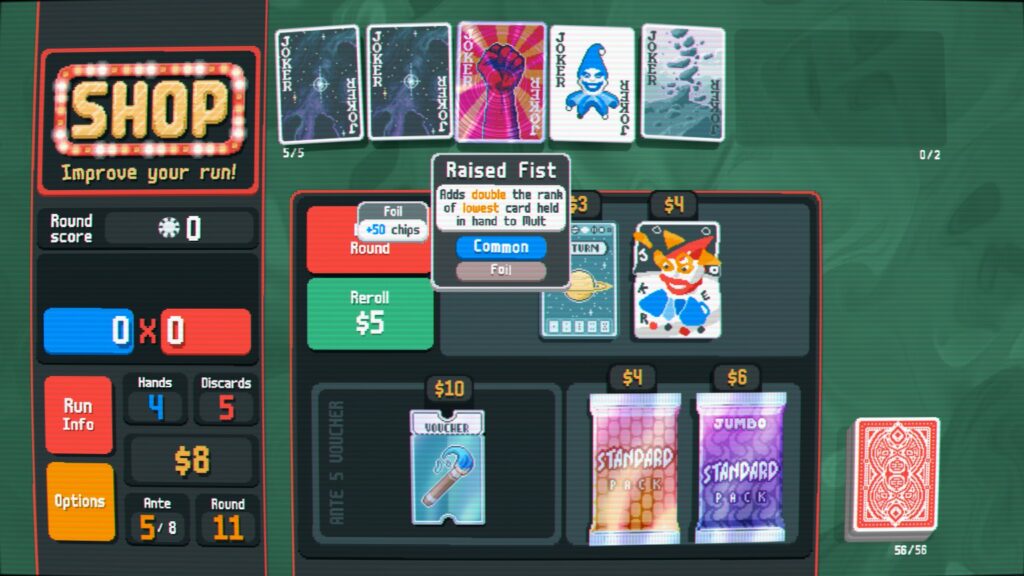
Balatro’s success was by dialing in exactly the core gameplay loop and making it appealing to that audience (source: steam)
7: Not marketing your game to the correct user base
Finding your consumer base is one thing, reaching them is another. You should be trying to find forums, message groups, even local game clubs in your area if possible to get in touch. Not only does this help grow the reach of your game, but you may find potential testers this way.
8: Over scope your game
An easy way to kill your chances of getting a game out is to over scope it — just keep putting more into it thinking that it will make it better. Part of being sustainable is knowing your limits as a designer to get a game out.
9: Spend too long figuring out what your game is
There is always a difference between thinking about your game in your head and actually sitting down in front of a computer to design it. Designs can change for many reasons — the idea isn’t good, the idea is too big, you have a better idea, and so on. Some designers can figure this out within weeks of a project; others can, unfortunately, take years.
10: Not have a plan for developing it
What makes game development hard for new designers is that you are trying to build a game at the same time you are learning how to build a game. One of the most common reasons that leads to development bloat is not having an idea of how to build said game. A simple idea can turn into weeks or months of you reading books, taking courses, or just trying to figure it all out on your own.
This is why sustainability and shorter dev cycles is important when you are starting out, as it allows you to start learning the process that goes into making a game and to start building your skills up.
11: No idea for art
The fact of the matter is that art is important for selling your game. For many developers, they either use stock images and create “programmer art”, or lately, turn to AI to create images. Both options don’t work — programmer art doesn’t sell to anyone outside of the hardcore minority, and many gamers and critics aren’t interested in looking at a game that was built with genAI today.
If you are serious about making a game and selling it, you need to sit down and think about the art that you can do or find someone to create the art you want.
12: Don’t have a great trailer
To go with the art point, your game needs a trailer to sell people on it, and that means creating a good trailer. I could spend an entire post on effective trailers, but to make it straightforward:
- Trailer must be no more than 80-90 seconds.
- It must show the selling point of your game.
- Information about the platform it is on and release date.
13: Don’t set up a store page
Another easy fumble is not setting up your store page correctly to get people interested in your game. This includes everything from an attractive capsule art, to making sure you use the right tags, have gifs and screenshots, and more. Remember, it’s not Steam’s job to sell your game, they are just providing a stall for you to do the job yourself.
14: Don’t update store Images
The next two points are easily forgotten on top of everything else you’re going to be doing, but you need to update your marketing materials as your game evolves. You should never have images or any content on your store page or marketing that is no longer relevant. If your game does get an art update or change, then all images and marketing must be altered to reflect that.
15: Use beta footage in trailer
It’s easy to think that you should get a trailer out as early as you can, but the trailer is the big moment for your game’s marketing, and you should not rush that. A common misstep I see from developers is putting out a trailer that has old version numbers on it, different versions of your game, or just showing off the very first version with all placeholder art.
When you have something good to show people, that’s when you want to get a trailer ready.
16: Don’t do any playtesting
Another required part of building your game is making sure to get playtesting done. You can start with close friends and family, but you must eventually get eyes on your game who will tell you directly what they think of it. Many designers struggle with this point, which leads me to this.
17: Did not learn anything from playtesting
Doing playtesting is not enough, you need to understand the feedback you’re getting. This is another point that I could dedicate an entire post to, and one that many first-time developers have failed at. If you show your game to 100 people and they all can’t figure out how to play it, that’s not on them, that’s on you. Part of the challenge is that you need to be able to dissect what people say and figure out what the root of their compliment or complaint is.
18: Only playtest once
As your game continues to grow, so will your need to playtest. This means finding more people of different skill levels and having an idea of when to do a playtesting session. Going into it, you should ideally do playtesting for the entire game, but if you are making something unique or an original system, you may want to do playtesting focusing solely on it. Nevertheless, playtesting is not a one-and-done thing, and the best designers know to get regular feedback.
19: Pick an overused genre
Every year, like clockwork, there will be a new hit game to dominate the conversation. And like clockwork, every year I get to see developers chase the new trend. Many first time, and even established designers, will try to rush and get in on the trend with a quick take on it. I think I can count on two hands how many successful bullet heavens came out that weren’t Vampire Survivors.
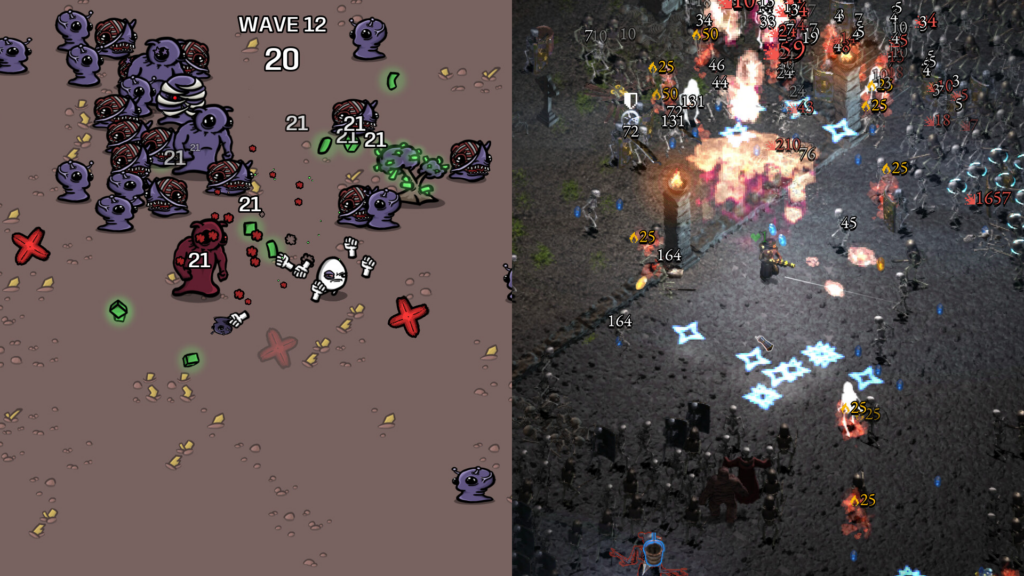
Just repeating what other developer do is not how you succeed, and games like Brotato and Halls of Torment managed to do something different for bullet heavens (source author)
You need to be able to sell people on a reason why they should play your take on a popular genre, and that often means doing something very different with it. At the same time, you must understand what made the game popular and not create a worse take on it.
20: Pick a genre that no one knows about
Part of marketing your game is being able to get people interested in it, and that means selling them on what your game is. Another detail I see developers hate to do is create that one sentence description of their game, but it’s good to think about your game like this. If you are making something so out there that no one has ever heard of it or has a reference about it, how are they going to know if they’re going to like it? The days of making something 100% original are gone — every game has some trace element of a genre or game system, and it’s your job to be able to convey that to people.
21: Copy a popular game in a genre
While this may seem similar to #19, this is about directly copying someone else’s design. Another thing I’ve seen a lot of first-time developers do is just copy a game as close as they can, maybe change the art a little, and then release it. As I said, consumers do not want to play the bootlegged version of a popular game, and this is an easy way to convince someone not to follow your studio.
22: Copy Your Previous Game to the letter
Game design is an iterative process, but for many developers starting out, they tend to just focus on making the same game constantly. Maybe there’s a new character, or different palettes used, but it’s still the same thing we’ve seen already; warts and all. Consumers want to see you grow as a designer and try new things or improve on what didn’t work. That’s also important for making better games and not just rehashing. You only have a few chances before people will write you off entirely if they see that you’re just making the same game all the time.
23: Overdesign your game
If there’s one thing that is always an attraction for indie developers with their first game, it is to make “the dream game.” One of the most surefire ways to ruin your chances of finishing a game is to plan too much out of your first title. When you are building your first game, you are going to be splitting your focus between learning the tools and coding and actually designing it.
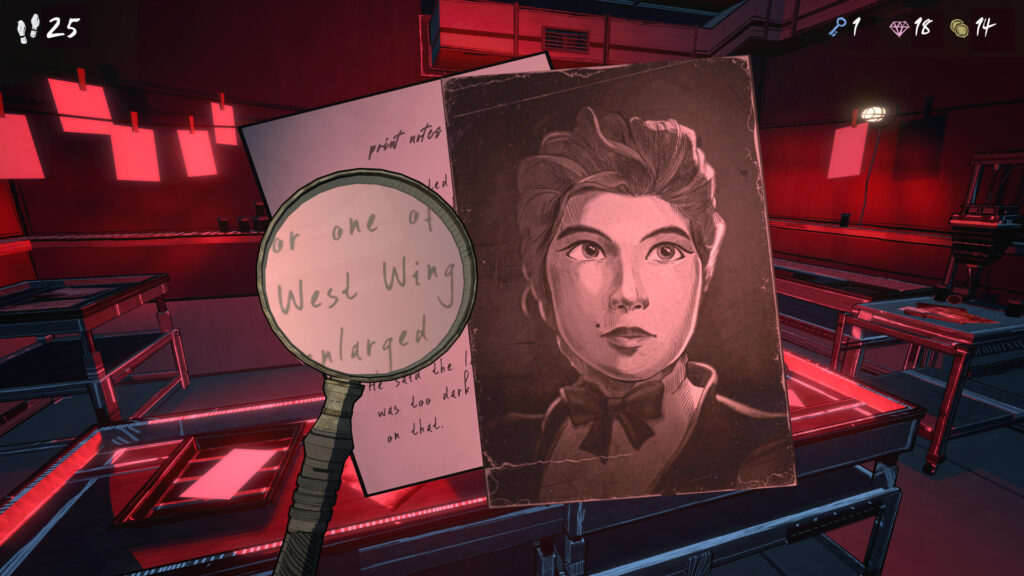
Despite the successes like Blue Prince, the days of spending 5+ years on a single game are coming to an end if you are an up-and-coming indie dev (source steam)
If you are planning on working for more than 3 years on your first project, that is way too long in today’s market. Most developers I’ve been interviewing today are spending anywhere from 12-18 months, as they know not to overcommit to a single idea. As another point, spending so long on one title will mean that it will be harder for you to have the resources or the drive to work on another game.
It’s easy to look at first-time successes as the model to chase, but many of these “first-time successes” are built off of multiple failed prototypes and early projects.
24: Under design your game
Just as you can go overboard with your game, you can also aim too low. The era where you could just copy another design, throw a fresh coat of paint on it, and then sell it for $4.99 is gone. There’s nothing wrong with looking at another design and building something out of it as a work project or for research, but if you are going to sell something to consumers, then it has to be uniquely yours.
You should be able to answer one simple question about your game: Why should someone play it over something else? And if you can’t, then you don’t have something that should be on a store page.
25: Don’t keep track of your budget
If there’s another aspect of game development that first-time developers can miss, it’s balancing a budget. There has to be money to pay the bills and keep the lights on if you expect to finish a game. For some developers, they may work on a game part-time and have a job that helps fund things. One thing that every established developer agrees on is that you should not quit a job to work full-time on your first game. You don’t need the added pressure of not knowing if you can pay your bills on top of building a game.
26: Go too early for Kickstarter
Kickstarter has radically changed since the successes of the 2010’s. You can’t go onto the platform with nothing more than cool ideas and expect to get funding. People want to see that you are both serious about your game and that you’ve put something into it already. At a minimum, you need to have a demo build that shows off the main gameplay loop and plays well.
27: Expect Too much from Kickstarter
Part of the previous point and the economy today is that people don’t have as much disposable income. It’s important when you are thinking about developing your game that if you really want it to happen, you shouldn’t be banking on your Kickstarter 100% succeeding; especially if this is your first major game.
Many developers have back up plans for their games if the Kickstarter doesn’t work — scale the scope down, try the Kickstarter again with a more complete build, or try to use the interest that was gained to find a publisher. This is also why you shouldn’t be taking your very first ever project to Kickstarter, as people will assume that the game is never going to be finished.
28: Overcommit from your Kickstarter
Stretch goals and bonus content are always huge sellers and boosters to a Kickstarter, but you need to reign it in based on what you are able to do. If the stretch goals for your game functionally make it a completely different game, then those goals are too big, even if they do succeed. What can end up happening without a plan is that the additional goals balloon the game’s development well past the point of the funding that was made.
29: Ruin your budget with bonus goods
It’s easy to dream big with Kickstarter and come up with all manner of bonus items, but the more you come up with, the more you have to actually develop and ship. Physical goods can be the bane of any Kickstarter project if you’re not prepared for the logistics that go into manufacturing and shipping. This is part of the research and planning that must be done when you are preparing to go to Kickstarter. You need to have this figured out long before you’ve launched your Kickstarter, as this can come back to haunt you.
30: Do not plan your Kickstarter budget
Figuring out how much money you’re going to actually need to make your game can be tough for first-time developers, or those that have never managed the budget-side of game development. What we see are two extremes when it comes to problems:
- Undervalue your budget thinking that it will make it easier for the Kickstarter to succeed.
- Go very high and try to get everything you want.
You should never intentionally go lower than you need, as I’ve seen games that have done just that and end up failing as the developers were not able to do what they promised given they didn’t have the money they actually needed. Going big can work if you are already established and have a proven track record, but not if it’s your first game out of the gate.
31: Do not organize your team
Whether you are working with one other person, ten, or dozens, there needs to be some kind of organization about who is doing what. Project management is an underrated skill when it comes to game development, and while you don’t need to worry about other people if you are a solo dev, this will come back to bite you when you are trying to scale up.
32: Keep Adding Systems
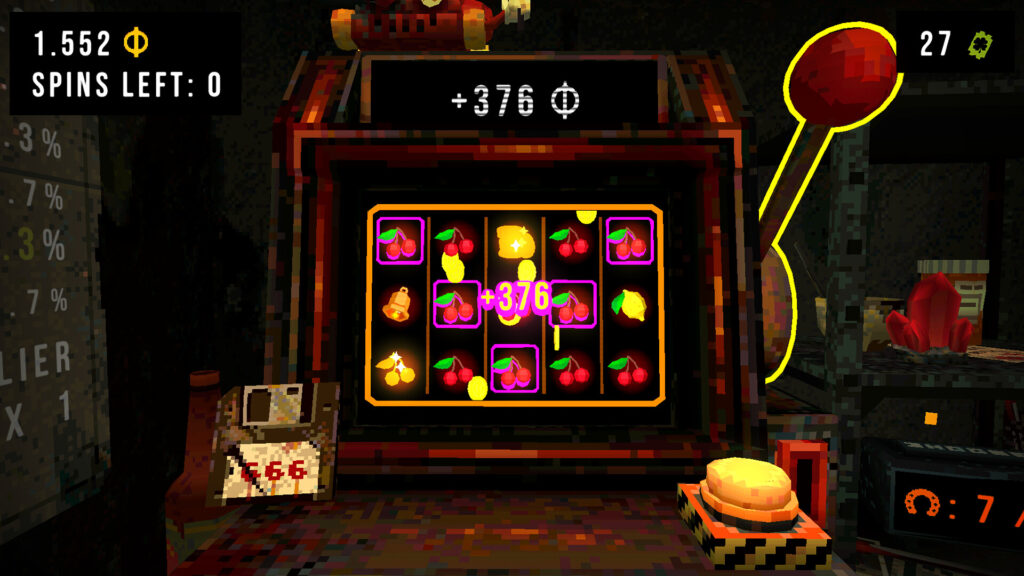
Clover Pit, and Buckshot Roulette’s success is about taking a simple gameplay loop and polishing it out, rather than trying to build the largest possible version of it from the start (source: Steam)
The allure of just adding more to your game has been a temptation for many game developers, and the cause for projects to balloon out of control. Just because game X has something cool in it, does not mean you should immediately scrap what you’re doing and add it into yours. Everything in your game must have a point for being there; if it doesn’t, then it should be removed.
Focusing on your core gameplay loop will allow you to determine what your game is about and make additions or subtractions when need be.
33: Never finishing your base game
And now it’s time for the shot’s fired point. How many of you reading this have gotten somewhat far into a project for you to just stop for one reason or another? Game development is about finishing a game, which I know is a shock. If you don’t finish your game, then you’re not taking the game dev cycle all the way to the finish line and learning how to improve for your next one.
Sometimes, a game doesn’t work, and there’s no shame in shelving it. But if you keep shelving every project and not finishing it, that’s a problem. This is also again why starting out small is good, because it’s easier to finish a 12–18-month project, vs. one that takes 3-5 years.
34: Never show your game off
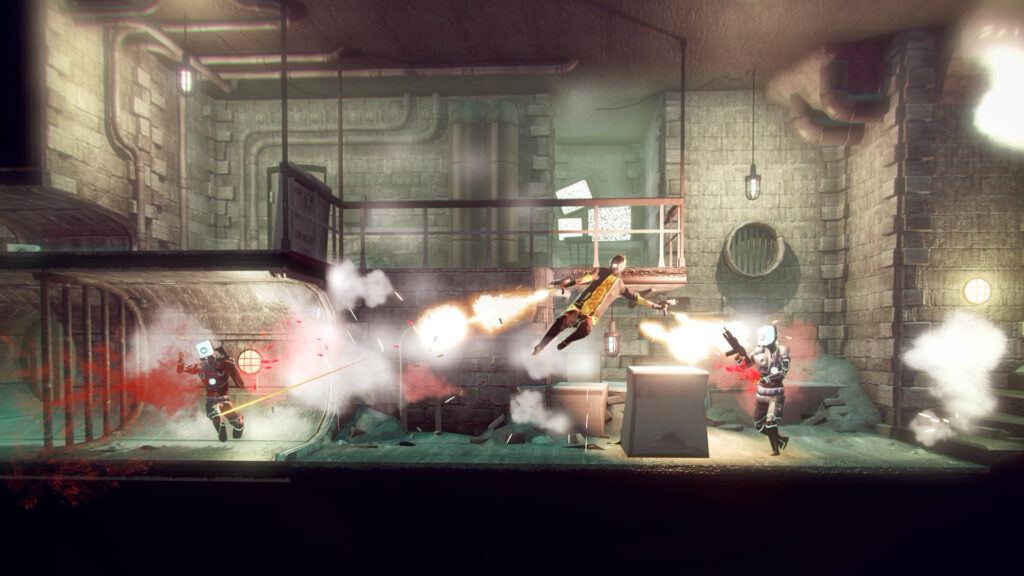
I still remember when I saw some random footage from My Friend Pedro on a facebook group years before it got picked up by Devolver, again, all it takes is one good piece of marketing to get it all going (source: Steam)
A continuation of the point about play testing, you need to be getting outside feedback on your game. Whether this is playtesting, showing it off at conventions, or just letting your friends and colleagues look at it.
From a marketing perspective, showing your game off allows you to build buzz off of it. All it takes is one great gif or image and things can take off. There are examples of games that found publishers or just received a huge marketing boost just by showing off 5 amazing seconds of gameplay.
You cannot go dark as a developer these days and wait until the last minute to mention that you have a game out. The moment you have something unique, cool, or interesting to show, get that up there on social media. Developers want to see other developers succeed, and they want to show these things off.
35: Keep Switching Game Engines
Part 2 of “don’t finish your game project”. The game engine you’re working in is going to affect what you can and can’t do, and the ease of it. There are now more available and powerful game engines that you can start learning for free than ever before.
What you want to avoid is having to switch engines for one reason or another — maybe there are limitations, maybe you think you can do more with a new engine. Be aware that rebuilding your game in a new engine means dealing with all new constraints and work that needs to be done. In some cases, this can be a benefit, but make sure to do your research first, as the last thing you want to do is switch to a new engine, to then switch back to the previous one.
36: Make Your Game Too Easy
While every year’s new “hard game” brings with it discussions about making games easier, a not so dirty secret is that there is a point when a game is too easy. Every game needs a hook to keep the player going, and if you are creating a gameplay-focused title, then there has to be something within that gameplay that keeps people playing beyond just having more levels.
I’ve seen games where the tagline is, “here’s 500 levels,” and those 500 levels are all pretty much the same. Making a very easy game with no challenge or growth will lead to a bored audience. Just as there is less time to be playing 80+ hour games (more on that down below), there is also less time to be playing something boring in the hope that it gets better later. If you want to make a game entirely focused on storytelling, that’s perfectly fine, but then your story better hit it out of the park.
37: Make Your Game Too Hard
Everyone likes to bring up “git gud” as the rallying cry for Soulslikes and difficult games, but the truth of the matter is that very few people in the market itself like to play overly difficult games. For many, if they die or lose a run within the first 10 minutes of playing a game, they’re going to stop. The proof is the high churn rates of many popular, but hard, games within the first hour.
And to go with the last point, assist modes and accessibility features do not contribute to lowering the difficulty for the general consumer. We have seen time and time again that if someone gets frustrated at a game, even if there are assist features to remove that problem, they are just going to end up quitting and not bother with them.
While you can attract a niche and rabid fanbase for it, this will often not translate into sales. Even if the game does blow up, it will lead to a lot of people watching the game but not playing it.
38: Making Your Game Too Slow
Returning to an earlier point, how many people reading this have a spare 60-80 hours a week to dedicate to one game? The era of “this game is good after X hours” has passed us. You have, at most, 30 minutes to an hour to convince someone that your game is worth investing time in, because they can go to any other game that’s out there at a moment’s notice.
Slowness also refers to movement, shooting, any kind of action in your game. If your game is being marketed as a shooter, or a fighter, and those elements feel slow or poor, that audience is going to flee from your game.
39: Making Your Game Too Fast
Conversely, asking someone with no experience in your game to immediately master it or die is not an engaging prospect either. There is an art to good pacing in a game: making sure that expert players don’t feel bored, without ruining the experience for someone who is just trying to learn.
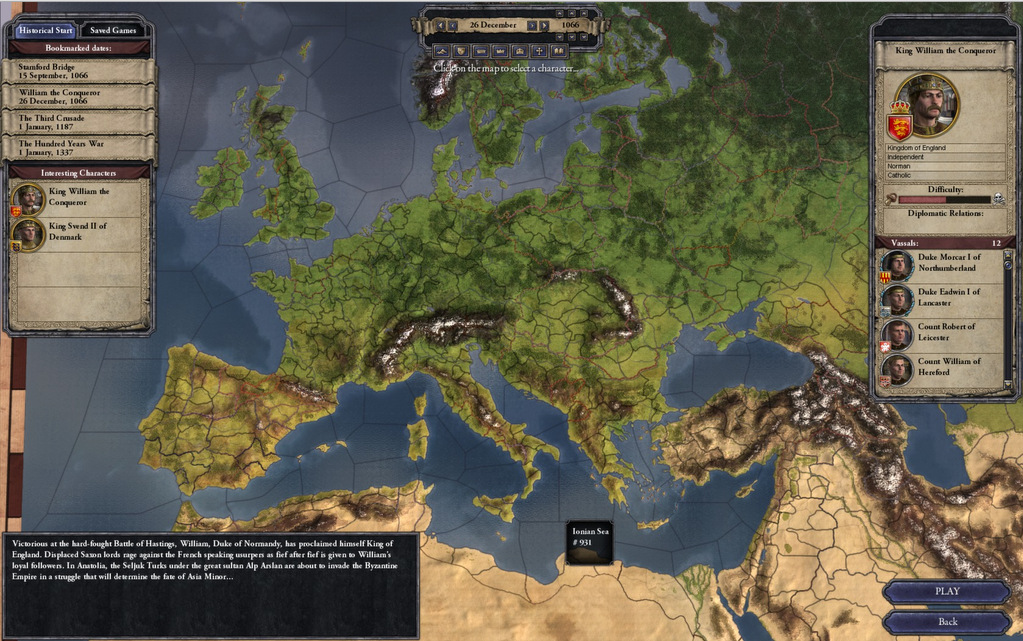
Grand Strategy games are the biggest culprit of this point, and we’ve yet to see one that makes the learning process easy for new players. (source steam)
The worst feeling in this respect is loading up a game and being completely overwhelmed by everything that’s going on. This is often why a lot of people don’t like to try out new genres, as the thought of being rushed into the deep end doesn’t interest them. It’s also why I’ve avoided 4X and Grand Strategy games for the longest time, as I’ve yet to find one that is easy to learn.
40: No Onboarding
I’ve said this before; there is no game being released commercially today that should have zero onboarding in it whatsoever. Every game is someone’s first, and even then, if you’re making something original that hasn’t been seen yet, all the more reason to include some amount of onboarding.
We can even extend this thought process to the previous point about pacing. Good pacing isn’t about putting someone in a game and going from 0 to 1,000, and it’s not about going from 0 to 0.10. Your goal is to provide a measured approach to onboarding and the pace of your game.
41: No Key rebinding
Something I still see indie developers, and surprisingly some AAA studios, which is not allowing the player to rebind their keys. There really isn’t much to go over with this point, there are people out there who like to rebind their keys to their preferred way of playing, and there isn’t an argument anymore not to include this feature.
42: Limited Control Schemes
An alternative problem is when in lieu of having key rebindings, developers simply create stocked control schemes. The idea is that each control scheme could serve a different style of play — A uses the right trigger for shooting; B uses the left.
For very technical games that are about mastering a unique control scheme, this is a band-aid fix at most. To the last point, sometimes, people will prefer an unorthodox way of controlling their character.
A popular example for me is if a game features multiple attack types and I prefer to use one or two, I may move the other ones to buttons that I don’t normally press and try to focus on the ones that I like. If a game is built for keyboard and mouse, where you have a lot of keys to build a control scheme around, then there better by a way for players to change things.
43: No options
This is strictly an indie problem, and one I see from first-timers and students. If you are releasing a commercial game, then it must have an options menu that includes, but is not limited to:
- Sound
- Visual
- Controls
- Graphical Features
Not only is this good practice, but it raises the quality of your game. I don’t want to turn on a simple 2D platformer that has screen tearing because there’s no V-Sync and is running at 10,000 FPS with no way of changing it.
44: No Accessibility Features
The days in which you could use deafening sound effects, seizure-triggering lights, while requiring 300 APM button pressing are gone.
Likewise, purposely designing your game around seizure-inducing effects, RSI causing button mashing, no longer work. Accessibility is not something you wait until the final hours of your game to start thinking about, but something that should be there from the beginning.
45: Blow Up the Consumer’s Computer
Another simple one but needs to be said. While it’s okay to miss a few bugs, especially if you are a small developer with no QA department, your game should still be functional if you intend on selling it on any platform. And if someone does find a nasty bug with the game after release, then you need to go out of your way to fix it if you still want people to buy your game.
46: Using GenAI For Game Development
The debate over GenAI may still be going on among other industries and larger studios, but for indie dev, it’s settled: DON’T USE IT. The audience of people who are going to be buying indie games are those that know developers and want to see them succeed while putting out something creative. Using Gen AI towards this group is an insult, and they will tell everyone they know not to look at your game. On top of that, developers love to promote each other’s games, and if they see one that has been built with GenAI, they will let everyone know to avoid it.
47: Incorrect Pricing
Pricing is one of the hardest parts of releasing a game: If it’s too low, your game will never be able to recoup, and you may drive people away who think it’s low quality. If it’s too high, people will think the game is a rip off or will just wait for a sale or forget about it. Then there is the issue with multiplayer games that demand a community to even be functional. Pricing them wrong can kill a game’s chances immediately.
A recent interview with the developers of Peak gave an interesting perspective on the matter:”
In a player’s mind, what does it mean to spend five bucks? Well, that’s five bucks. But six bucks? Well, that’s still five bucks.
Four bucks is also kind of five bucks,” “Three bucks is two bucks. And two bucks is basically free.
So we’ve got these tiers: You know, twelve bucks… that’s ten bucks. But thirteen bucks is fifteen bucks.
And we found that eight bucks is still five bucks. It doesn’t become ten bucks. Seven ninety nine, that’s five bucks, right?
So, eight bucks going to five bucks is the biggest differential we could find in pricing, so we found it very optimal.
Pricing requires you to look at the market for your game and where the perceived value comes from. You cannot price your game strictly on visuals alone anymore — stating that a pixel art game doesn’t deserve more than $10, or a UE-developed game automatically gets $30. For games that are meant to be experimental, you need to consider that with the pricing: is someone going to want to spend $20 or more on a design that they’ve never seen before?
There is no easy answer to pricing, and yet, getting it wrong can easily kill any momentum that your marketing managed to achieve.
48: Over-commit to post-release support
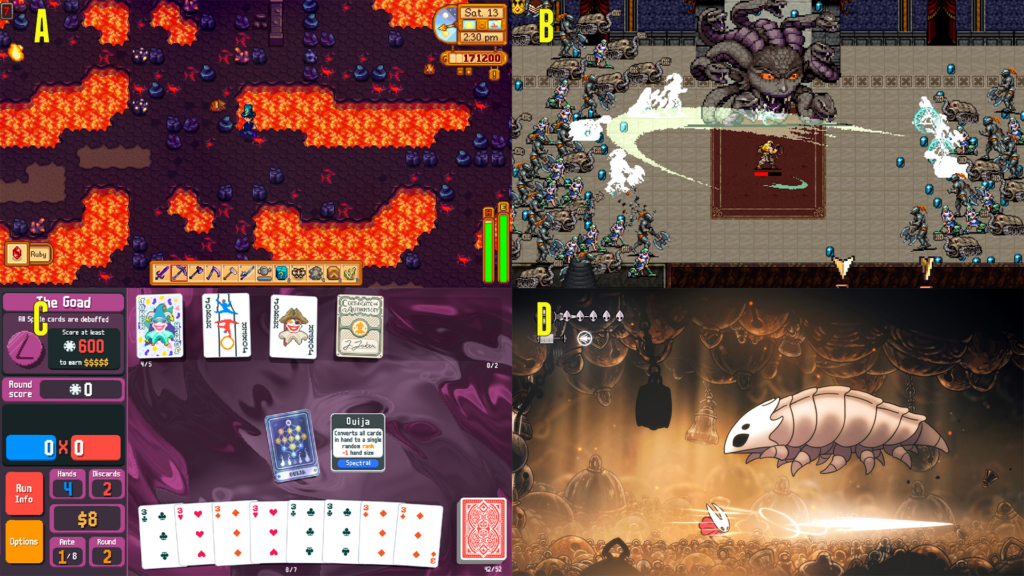
Only some games have the privilege of an almost infinite source of income and fan interest to keep seeing content come out for it and you cannot plan your game around this to happen to you (source: Author)
A new problem that developed over the 2010s was the rise of post-release support and DLC. When it works, it greatly extends the life and sales of a game and becomes the gift that keeps on giving. When it doesn’t, it can sink a game’s revenue and lead to diminishing returns.
However, just ignoring any thoughts on post-release content can also hurt a game and prevent a developer from striking while the fire’s hot. It’s important to think about what content in your game is absolutely required to be in it, and what could be considered expanding on if your game does well. This is another part of making games sustainably and focusing on small titles. Instead of version one being every single idea you’ve ever had for the game, version one is a complete, but small game. If it gets big, then you have a variety of ways to expand; if it doesn’t, then you move on.
Even if you have a best-selling game that blows up, that doesn’t carry with it infinite support. There will always come a time when there are literally no more ideas left. As a designer, you need to know when your game is completely and utterly “finished.”
49: Only have one game idea
There was this period in the 2010s as developers were first getting into indie dev that the common message I kept getting was “this is my dream game that I spent X years on.” And every time I asked a developer what they wanted to do next, they had no idea.
The biggest change in development mentality now compared to the 2010’s has been talking to developers of smaller games – no more than 18 months to 2 years of dev time. The idea of spending 5+ years on a single game is considered crazy. More importantly, when I interview a developer today and ask them what they want to do next, they always have multiple ideas.
If you want to survive long-term in the industry, you cannot put all your eggs in one basket and hope that one game is going to be your ticket to success. People like to point to titles like Balatro of having that sudden appearance of success, but every game that “just appears” is often built on the backs of failed projects, and unreleased prototypes.
50: Never release anything
The last, and most painful point is never getting to the point that you can release, well, anything. Some developers are perfectionists, some keep chasing the latest trend, some are afraid of showing their work off. If you want to be considered a game developer, you need to release something. Thanks to Itch.Io, you don’t even need to spend money for a store page.
Getting a game “release-ready” is the last step, and one that can feel like torture the first time you do it. However, no matter how painful it is, you need to rip that bandage off. Learning how to finish a ship a game are the skills that will make your next game easier to finish.
This also relates to getting the store page finished and the other marketing beats mentioned earlier. Any mistakes you do make are lessons for next time.
And with that, the list comes to an end, but there are still many more ways that a game can end up failing. If you would like to contribute to the sequel, let me know what are you favorite ways in the comments.
Be sure to follow me on BlueSky and check out all the other places I’m around ranting about game dev.