Marvel Midnight Suns is another game on my list to get around to playing. A break from Firaxis’s norm of making strategy games. The studio created a deck building RPG in the Marvel universe with many well-known characters. Following the release, the game has been considered a sales failure, but to the people who stuck with it, there have been talks of it being a hidden gem. Having played it, there is a great concept here, but it’s hidden under a lot of Marvel melodrama.
Hunting Lilith
Our story finds the Marvel heroes under the attack by the demon Lilith, who is corrupting villains and Hydra to try and take over the world. To aid them, they resurrect her child, who is referred to as hunter, who defeated her in the past and that becomes the player’s character and POV for all things Marvel.
While you start with a cast of characters who make up the Midnight Suns, magical and supernatural-based heroes, you’re soon joined by fan favorites and major names like Iron Man, Spiderman, and much more. The structure following a day/night cycle with a mission in-between. During both, you are free to wander around the abbey that acts as your hub and the surrounding area looking for side quests. Past the opening tutorial, you can choose from different missions that will often require you to take a specific hero or hunter along.
The heroes you choose to take along are a big part of Midnight Suns’ progression, and brings up the oddest comparison one could make to a Firaxis title.
Super Relationships
Midnight Suns at times feels like an attempt at creating a western version of the recent Persona games. Each day, you can hang out with the different characters to try and raise your relationship status with everyone. Characters will love to tell you their backstories, and everyone grows to like hunter.
From a gameplay perspective, this is just one of the many different progression routes that is going to be needed if you want to get access to everything. Each individual character has a relationship level, and the team itself has an overall one. Increasing the team level will unlock new bonuses — most importantly, a special combo card that does massive damage that can be played once per fight. At level 2 relationship, each hero gets a permanent passive and this can grow as their relationships get higher. These passives are also designed to help ease some of the challenges of the combat that I’ll talk about further down.
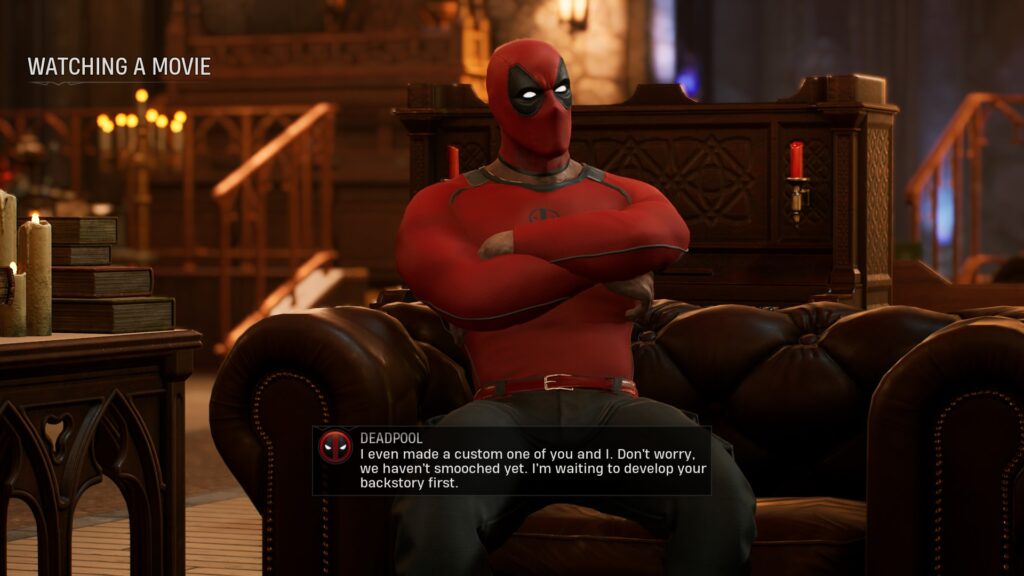
Getting into a relationship with Deadpool is either the best or worst thing possible (source Author)
Midnight Sun’s design is built heavily on rewarding the player for their choices. Characters earn XP while they are used on missions, you’ll be able to select new card rewards based on the characters who were on a mission, and there are special character quests that pop up from time-to-time. Copies of cards can either be combined to upgrade the card or sold for resources that can let you make use of the other systems.
With that, we can talk about the card combat which is the game’s major gameplay, and where things start to mess up a bit.
Turning Up
Midnight Sun’s combat is different from other deck builders and deckbuilding RPGs. Each character including hunter comes equipped with unique cards and often a unique skill or advantage during combat. Iron Man’s cards can gain bonus effects if you redraw them, while Ghost Rider’s cards are typically stronger on average, but will do something negative to balance them out.
Each turn, you are able to play three cards, redraw two cards, use craftable items, and do one “move” that I’ll come back to later. A big aspect of the design is that you are very limited in terms of card playing and card draw; your team during a mission consists of up to three heroes, and each hero has a deck of no more than 8 cards. Cards can either add or cost “heroism” which is the resource needed to play your bigger and more damaging cards.
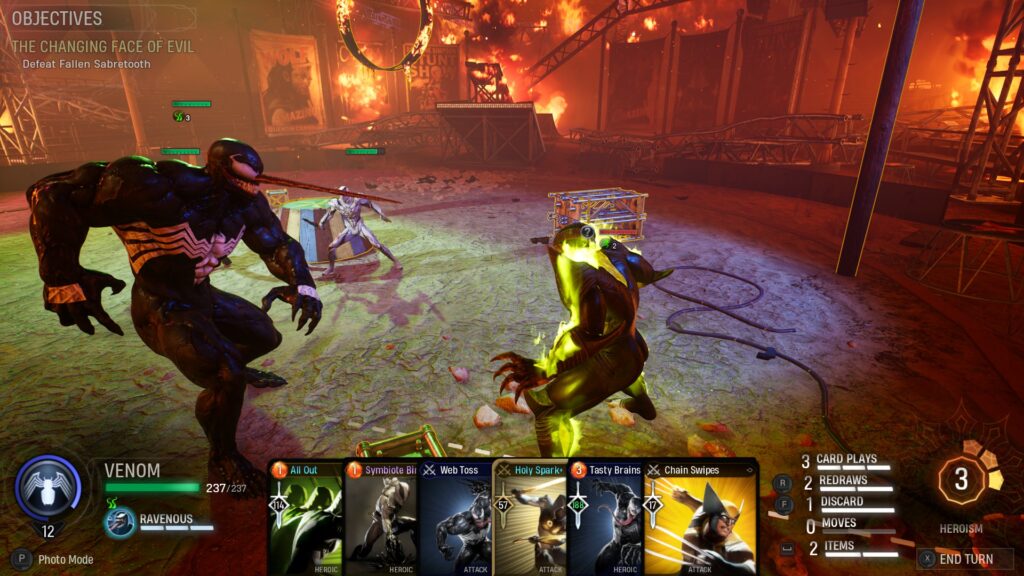
The card variety and options are some of the best I’ve seen (source: Author)
To the game’s credit, the card designs are well done, not only matching the different characters, but offering a variety of options that you can use during combat. I like how the game incentivizes the player to find characters they like, and do more with them to unlock more content and options for them.
However, the problem is that all these different abilities and characters are being factored into a combat system that demands you play it a specific way.
Not So Marvelous
To understand the difficulties of Midnight Sun’s gameplay, it comes down to how combat plays out.
Every turn that there is an active mission objective, enemies will spawn in. There are three enemy types in the game — grunts who die to a single hit, elite enemies with actual health bars, and bosses who have two actions per turn and multiple health bars.
You will rarely have a turn where there aren’t at least three enemies on the field at once, and remember, I said that you can only play at most three cards per turn. To get around this, the only ways to recover your card plays are to use cards that have the “quick” tag, or defeat enemies that are “marked.” The move command I mentioned further up can be upgraded to let you get a free shove on an enemy; enemies who are shoved into the environment or other characters take contact damage.
The idea is that you use your quick attacks and anything with knockback to deal with the grunts, and save your heroism cards for the elites and bosses. But being outnumbered means that it’s almost impossible to avoid any damage each turn. And if you have a turn when none of your quick cards show up, it’s not going to be possible to deal with everyone.
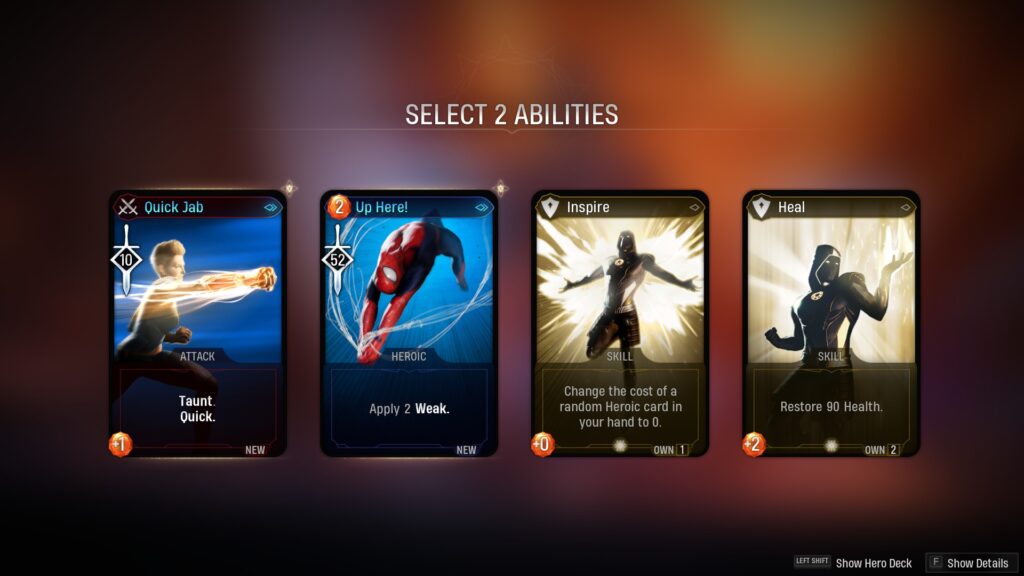
Difficulty as you get further in is highly dependent on which cards you are actually pulling (source: Author)
Because enemies spawn while there is an objective to a certain number, any time you are not either attacking elites or bosses, or trying to complete the mission, you are falling behind. This is not like XCOM or Mario + Rabbids where players can use the environment to defend themselves. Only certain characters can gain block, and outside of healing items, there are very few cards that provide healing or life steal.
And when you combine that with constant enemies, most of your deaths will come from getting chipped down each turn. Due to those factors, it reduces all the different characters and their playstyles into only a few safe ways of playing:
- You need AOE or quick cards to deal with the grunts
- One high damaging card to either kill or greatly wound elites and bosses
Everything else is either too situational or too slow given the amount of incoming damage each turn. If you try to do harder missions where enemy stats are even higher, you can easily lose most of your health after two or three hits. Speaking of stats, characters level up while on missions which increases their base stats and this affects the strength of their card values.
Some of the advance enemies and bosses are painfully annoying to fight due to the limitations in the design. When you start fighting bosses who can summon their own minions on top of reinforcements, or provide unique and specific buffs, three card plays per turn is just not enough if you aren’t already prepared for it.
I do wonder, given the power of the relationship and team bonuses, if the game was designed around people spending more time grinding general maps just to get more socializing done each day to acquire those bonuses.
Remember that I said that the game incentivizes the player to keep using characters they like to get them more cards and more abilities. However, many story missions will require the player to take a specific hero or heroes with them, and if you didn’t use them, you’re going to be at a disadvantage. The game says that missions scale to the average level of the party, but that doesn’t account for having better cards that help out. And using a character that you haven’t unlocked cards for can be a pain, as some characters don’t shine until you get one of their better cards. Both Captain America and Captain Marvel are considered tanks and get access to taunt and defensive options with their advanced cards; without them, they lose a lot of their utility.
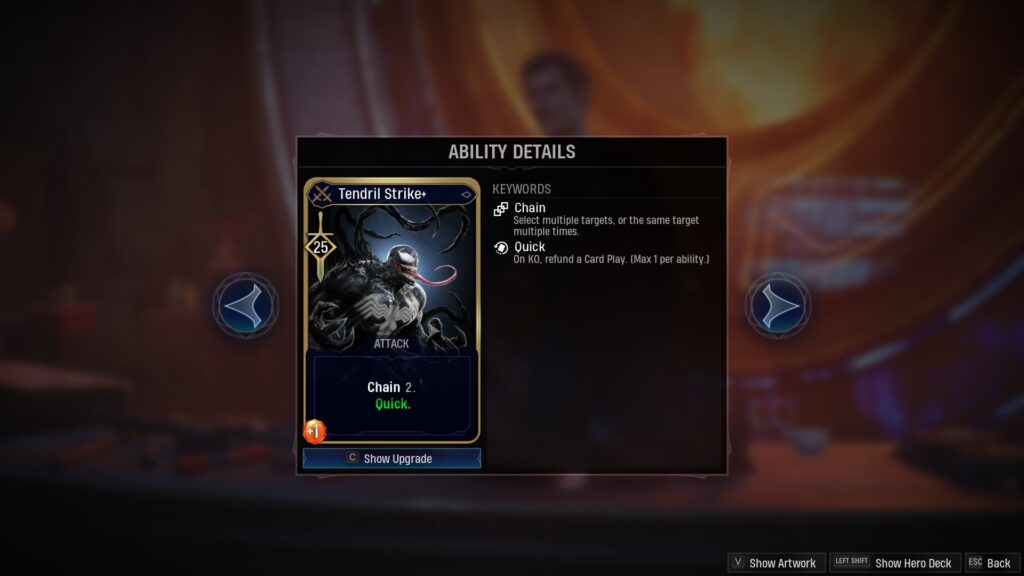
The card upgrade system does its job, and can radically change some of your options (source: Author)
It really feels like general defense was completely neglected as a concept from the design; requiring players to either fight fast or have a stock of items as backup. It also means you need to be mindful of the heroes you take on a mission, and certain combinations work better than others. For instance, Deadpool and Captain America pair well, because Cap has one of the best taunts in the game and that keeps enemies from attacking Deadpool who has a resource that is lost every time he takes damage.
The game also suffers a similar problem that the first Mario + Rabbids had, because hunter is a required party member for most of the story missions, it greatly limits team dynamics and combinations when they would matter the most. To compensate for this, Hunter’s cards are some of the best in the game in terms of providing multiple utility and damage during a turn. And Hunter’s suit upgrades do provide them with unique passives that you can swap in and out based on your playstyle.
Speaking of Mr. Pool, it’s time to talk about why a lot of people have churned out of playing the game.
The Real Game Begins at Deadpool
Midnight Suns is a very slow game to play. There are so many cutscenes and dialogue to sit through that if you aren’t a super fan of Marvel, it’s going to feel like pulling teeth to play. Be prepared to watch a lot of pre-canned attack animations and characters standing around emoting. Different clubs with the various members also extends the time and dialogue. The gameplay systems and card improvements are locked to several hours of going through the introduction and basic missions.
The game doesn’t officially begin until you start seeing the DLC missions pop up on the mission map, starting with the introduction of Deadpool. But to get to this point requires you to engage with Midnight Suns‘ most polarizing feature.
A Super Walkabout
All the day and night content I mentioned above takes place in an open area that you are free to explore; whether you want to or not. A lot of the early slowness is that the game requires you to do basic missions and side quests in the open world. You are limited to walking and running; no superhero stuff. There is an ongoing mystery that you can solve that will unlock bonus challenges and runes that are used for more exploration. It kind of gives off the vibe of the later “Krypts” introduced in the Mortal Kombat series.
However, none of this is directly adding to the entire deck building RPG side of things with the other heroes. You can acquire new cosmetics for hunter, but most importantly, this feeds into progressing their abilities and options. There is a light/dark morality system that unlocks additions perks and cards depending on the path you go. The open world is also the only way to acquire the ingredients and recipes to create new items — such as the very important healing I mentioned further up.
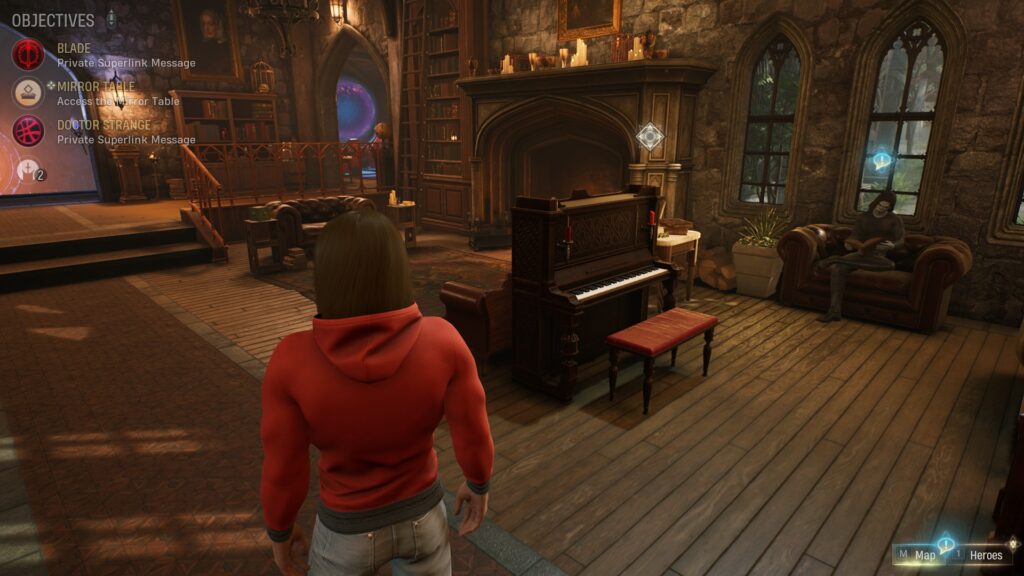
the open world exploration is great for Marvel fans, a pain for everybody else (source: Steam)
And its this inclusion that leads to the awkward pacing of Midnight Suns. You could spend an hour playing that consists of only 10 minutes of doing a mission, and the rest of the time having to wander around talking to everyone, doing side content, opening up rewards, and more. If this was more like other superhero games where the exploration is tied to super powers and quickly exploring, it would be a different story. Here, you literally can’t jump down from ledges unless they are specifically designed to do so.
The entire game just feels slow, and for a genre that is known for being on the slower side, that’s not good. The more I played into the game’s first and second chapter, I ended up lowering the difficulty as it all it was doing was lengthening the amount of time spent on each mission.
Slow Superheroes
By the game’s halfway point it dawned on me why I was running out of patience with it. There’s so much “stuff” in the game that gets in the way of its great combat system. Instead of feeling like a team of superheroes, it sometimes feels like I’m just standing around shoving goons into each other.
What the game is missing in my opinion is a reward of speed for mastery. In Mario + Rabbids, attentive players could use their multiple actions and special powers to easily clear the field of enemies. With Persona Tactica, there were numerous ways of quickly dealing with the overwhelming odds and the maps were designed to be fast to play.
Here, it started to feel like the game was fighting me when I tried to do more with its combat. You can’t easily set up advanced strategies with movement and shoving, because you only get one of those per turn by default. This also limits characters like the Scarlet Witch who features AOE attacks from her origin point, but that means giving up your free move. I wish that you had one “move” per character, with the team sharing the “shove” command. With only three cards to play normally, it makes buff cards that aren’t free borderline worthless if at most you can play 2 other cards that turn before the buff runs out and if you don’t use those buffed abilities on the higher-class enemies.
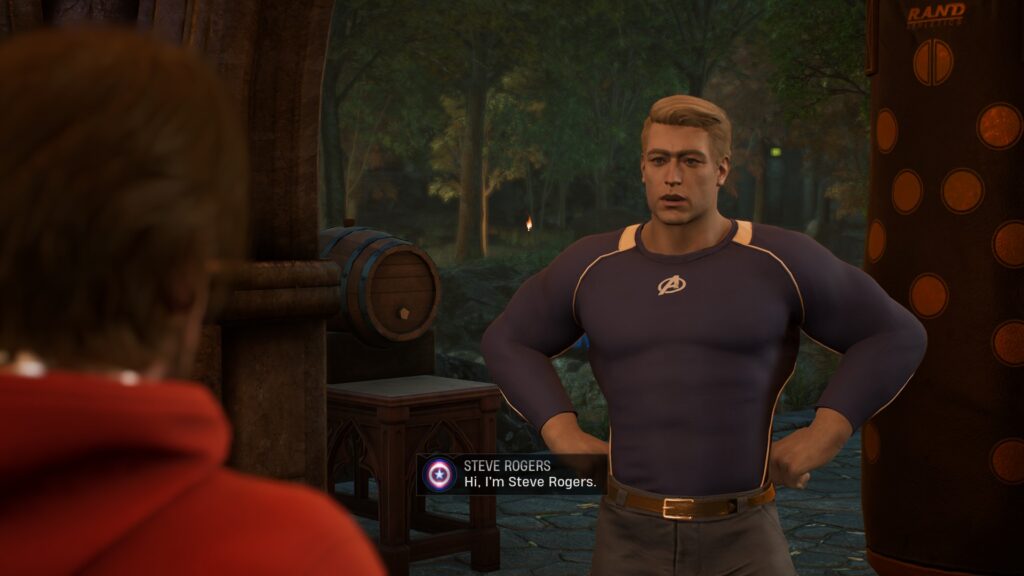
Get used to this pose, you’re going to be seeing it a lot during conversations (source: Author)
Using the generic enemies as heroism fodder works on paper, but there really should have been more for clearing out the wave of them each turn, like maybe refunding one card play for wiping out the reinforcements. The most exciting part I had was at the end of the first chapter when it looked like I was going to get to field 5 characters at once, to only realize the mission was a two-parter featuring two different teams with hunter.
It felt like I was always just one more card play, or just one more action per turn away from being able to do something cool. When you do get access to modded versions of cards that come with additional attributes and bonuses, along with a team that has their passive abilities, your options do become more open. However, keep in mind that what I’m talking about can easily take 15-20 hours of playing; more if you watch and listen to all the dialogue.
Ultimately, Midnight Suns feels like a game that doesn’t have an easily understood audience. If you’re a Marvel fan looking to interact with the characters, then the advanced deck building and combat may be too much to go through. If you’re a deckbuilding/RPG fan, the amount of Marvel angst and standing around listening to characters talk gets in the way of going on missions and refining your strategy. If you are in fact that super fan who is both heavily into deck building RPGs and Marvel, then this is your must-play game.
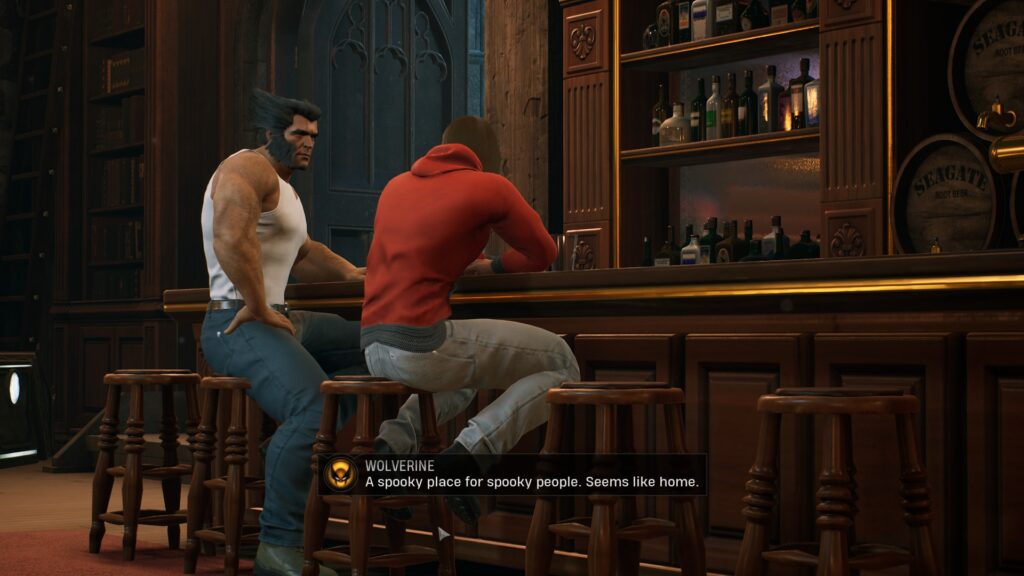
Alright, hanging out with Wolverine is also cool. (Source: Author)
I would play another game using these card dynamics and designs in a heartbeat, but no matter how talkative they are, I don’t feel like going bird watching with Iron Man or fishing with Captain America; I would watch a movie with Deadpool or Spiderman.
For more design ramblings, be sure to follow me on Bluesky