Every designer who has shipped a game with a wiki knows the feeling of being corrected by their own players. Someone builds a timeline, cross-references the codex entries, and surfaces the contradiction you introduced in a side quest eighteen months into production. Lore breaks are a systems problem long before they are a writing problem. The rule you established has to be stored somewhere, retrieved at the moment it matters, and checked against the line you just wrote, and most tools only do the first of those three.
In our own test, resurrecting a character was supposed to cost one memory; 200 pages later the spell was free, and only a reader noticed. We put seven AI story generators through an eight-scenario lore gauntlet. Here is which ones actually hold a map in their head.
How We Ranked Canon Retention
A story generator must clear a four-step relay: store → retrieve → verify → update. Miss one leg and canon slips.
We built a scorecard around that pipeline and weighted each stage by its real impact on draft quality.
| Stage | Weight | Why it matters |
| Canon retrieval & reinjection | 25% | Facts the model never “hears” can’t stay consistent |
| Fiction-specific generation | 20% | Good prose still counts |
| Structured lore tooling | 15% | Databases, relationships, and timelines cut manual work |
| Long-project architecture | 10% | Series support keeps trilogies from collapsing |
| Contradiction alerts | 10% | Flagging conflicts beats silent errors |
| Context, import-export, value | 20% | Usable window size, open formats, and cost matter |
We then ran each app through an eight-scenario “lore gauntlet” (resurrection costs, dead characters, three-day journeys, and more) and deducted points whenever a claim relied only on marketing copy. The process mirrors the 2026 ConStory-Bench approach, which treats contradiction detection as a separate pipeline instead of a side effect of larger models.
This blend of numeric weights and live stress tests underpins every ranking that follows.
1. DreamGen: Best Overall for Fiction-First Worldbuilding
DreamGen works like a studio assistant fluent in epic fantasy. Its story generator keeps the Scenario Codex as structured data such as locations, artifacts, and timelines, so when you advance the plot, characters recall secret pacts and magic costs stay consistent.
The app’s fiction-tuned models stage scenes whether you are in Story Writing Mode for prose or Role-Play Mode for dialogue. Because the Codex loads essential facts automatically, you guide the action while DreamGen supplies the right details and keeps the map intact, with no API keys or extra setup required.
Key specs worth noting: a 5 K starter context that scales to 30 K tokens on the Pro tier, plus eight first- or third-party models to choose from. That mix of structured memory, long context, and one-click setup is why DreamGen earns our top spot in this roundup of the best AI story generators for worldbuilding.
2. Novelcrafter: Best for Series-Scale Canon Architecture

Picture a trilogy where half the cast changes sides by book two. That shifting landscape is where Novelcrafter earns its place in our roundup of the best AI story generators for worldbuilding.
The Codex stores facts and tracks how they evolve. Add a Progression and the app remembers the queen loses an eye in Chapter 14, so the sequel never forgets her patch. Relationships are just as explicit: names, aliases, factions, even a three-person secret all live in structured fields. Mention a character and Novelcrafter can pull the right alias into context automatically, trimming token spend and headaches.
Because Novelcrafter is bring-your-own-key, you choose the model: OpenAI for speed, Anthropic for longer context, or a local build for privacy. Hobbyist plans that unlock AI start at $8 per month, and you control temperature, max tokens, and budget caps inside each prompt.
The trade-off is setup time. Expect an afternoon to import manuscripts and learn the Codex-first workflow. Once that is done, series writers gain a canon engine that grows with every chapter instead of collapsing under its own weight.
3. Sudowrite: Best for Guided Drafting With Relevant Lore
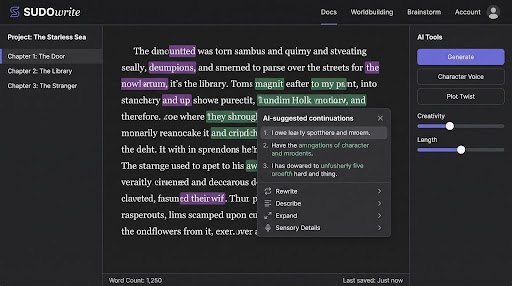
Sudowrite weaves your Story Bible into every draft pass. The Saliency Engine skims Character and Worldbuilding cards, lifts only the facts the next scene needs, and inserts them into the prompt, so the model stays focused without ballooning the token budget.
The payoff is speed and thrift. Click Write, and the engine decides a moon-phase rule matters for tonight’s heist while the capital’s tax code can wait. Because it feeds only the salient cards, scenes read tighter and an entry plan of 225 K credits for $10 a month lasts longer than a full-context approach.
Series support sweetens the deal: shared characters, locations, and outlines now live at the project level, and a project-aware Chat can answer “When did Mara learn the prince’s secret?” with a link back to the source card. Write mode can inspect up to 20 K words in the active doc plus 20 K across linked files, enough for most chapters.
The caveat is relevance. If a scene never mentions the prince, the secret he carries may stay offstage, even when it should block a reveal. Long draft runs or large imports can also chew through credits quickly.
For writers who want guided prose that respects key facts, and are willing to watch the cards the engine omits, Sudowrite is a standout in this roundup.
4. AI Dungeon: Best for Persistent, Playable RPG Worlds
Running a tabletop-style campaign? AI Dungeon works as a tireless stage manager. Its memory has three layers: Plot Essentials that stay in every prompt, trigger-based Story Cards, and a Memory Bank that recalls earlier events.
Open the Context Viewer to see exactly what the last prompt carried. When space tightens, AI Dungeon lists which cards remain and which are trimmed, so you can tweak triggers instead of guessing why lore vanished.
Membership tiers cap usable context at 4 K, 8 K, 16 K, or 32 K tokens, enough for marathon sessions but still a budget. Required facts load first; dynamic cards compete for what is left, helping GMs decide which secrets deserve always-on status.
Know the limits. The platform raises no contradiction alert, so if a Story Card drops out, the model may rewrite canon. Enjoy AI Dungeon for its improvisational freedom, but plan a manual continuity pass before calling your campaign lore-safe.
5. NovelAI: Best for Manual Lorebook Control
Prefer a tightrope over a safety net? NovelAI lets you hand-wire every rule in its Lorebook. Want a trigger that fires only when two keywords share a paragraph, or a regex that catches any “moon + eclipse” combo? Done. Mark an entry always-on and the AI never forgets that iron burns fae skin.
The payoff is visibility. Open the Context Viewer to inspect each entry, its trigger, and its insertion order. If prose breaks canon, you see whether the rule misfired or the model ignored it, creating an audit trail most rivals lack.
Limits are just as clear: no relationship graph, timeline, or contradiction alert. Context capacity ranges from 3 072 to 8 192 tokens depending on your plan, and the Tablet tier starts at $10 a month. You will spend time tuning prompts and budgets, yet tech-savvy writers may welcome that precision.
When pinpoint control matters more than automation, NovelAI stays a strong niche pick.
6. NovelCanon: Best for Explicit Contradiction Detection

Most tools trust the model to remember; NovelCanon double-checks. Its Consistency Engine reads each scene, extracts the facts on the page, and files them in a living registry. Launch a scan and the engine sweeps the manuscript for timeline slips, broken rules, or suddenly resurrected villains, then links every alert to the exact lines that clash.
Evidence is the point. Approve a fix and the registry updates, so future drafts stay honest without endless manual audits.
Because NovelCanon is bring-your-own-key, you pay only when you run scans. The Pro plan costs $12 a month when billed annually; provider rates apply per scan. Exports include DOCX, EPUB, and PDF, making hand-off to editors painless.
Limits remain. The product is young, and full-book scans can burn tokens fast, so schedule them like a professional edit pass. Still, if catching contradictions is your top priority, NovelCanon is the standout specialist.
7. ProseEngine: Best Emerging Canon-Enforcement Bet
ProseEngine positions itself as the most ambitious entrant in this roundup. The tool’s Story Codex compares every new sentence to your established lore, flags inconsistencies such as dead characters reappearing, magic rules ignored, or maps contradicted, and links each alert to the clashing lines. After drafting, you can run a series-scale audit on projects up to 500 000+ words, organized by violation type.
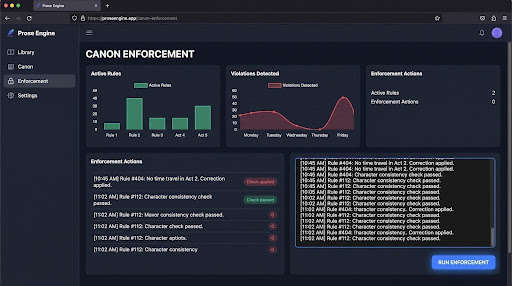
Choice is another draw. The interface can route prompts to 40-plus models, from GPT-4 to local Llama builds, letting small studios balance cost, latency, or privacy. Exports include DOCX, EPUB, PDF, and print-ready layouts, so an editor can step in the moment the Codex turns green.
Caveats remain. Independent reviews are scarce, and canon enforcement unlocks only on the Author tier (€99 a year). Treat ProseEngine like early-access software: enticing upside, but run a hands-on test with a sample manuscript before migrating a full series.
AI Story Generators Compared by Canon Retention
Below is the promised bird’s-eye view. The table answers what worldbuilders ask most: how each tool stores lore, whether it puts facts back into the prompt, whether it flags contradictions, and what it costs to unlock those features.
| Rank | Product | Canon mechanism | Re-injects lore? | Flags contradictions? | Usable context | Model choice | Entry cost* |
| 1 | DreamGen | Scenario Codex | Yes | No | 5 K–30 K tokens | Eight first- or third-party models | Tiered, see live page |
| 2 | Novelcrafter | Codex + Progressions | Yes | No | Model dependent | BYOK | $8 / mo + usage |
| 3 | Sudowrite | Story Bible + Saliency | Yes | No | ≤20 K current + 20 K linked words | Muse, Claude, GPT, Gemini | $10 / mo billed yearly |
| 4 | AI Dungeon | Essentials, Story Cards, Memory Bank | Yes | No | 4 K–32 K tokens | Tier dependent | See membership page |
| 5 | NovelAI | Keyword or regex triggers | Yes | No | 3 072–8 192 tokens** | Proprietary | $10 / mo |
| 6 | NovelCanon | Living fact registry | Yes | Yes | Model dependent | BYOK | $12 / mo billed yearly + usage |
| 7 | ProseEngine | Story Codex + audits | Yes | Yes | Model dependent | 40+ options | €99 / yr for enforcement |
*Entry cost reflects the lowest plan that includes the lore features described.
**Vendor FAQ lists 3 072–8 192 tokens; verify in-app before quoting a hard maximum.
Three patterns stand out.
- Feeding better context still beats policing it. DreamGen through NovelAI sit in that camp.
- Only NovelCanon and ProseEngine add a second pass that cites contradictions, so they rank lower today but could rise once third-party tests confirm performance.
- Window size is not safety. AI Dungeon can send 32 K tokens, yet Story Cards may be trimmed when space runs out, so retrieval rules and visible context viewers matter as much as raw length.
Use the table as a quick checklist. If you need automated warnings, start with the last two rows. If you want a hosted, fiction-first workflow, the top three will get you writing faster.
What to Consider Before Choosing a Worldbuilding AI
A flashy demo does not guarantee a tool will keep your canon straight. Run this six-point gut check before starting any trial:
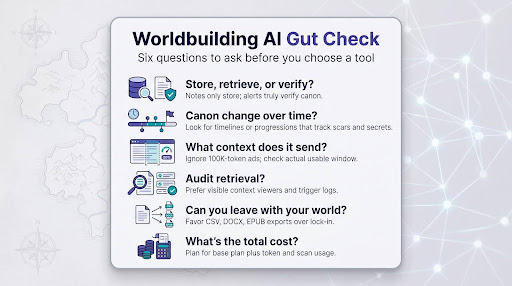
- Store, retrieve, or verify? A notes pane only stores. Automatic context retrieves. A flagged alert provides real verification.
- Can canon change over time? Look for timelines, Progressions, or event-based updates that track scars, secrets, and shifting allegiances.
- What context does it really send? Ignore “100 K tokens” ads; open the viewer because many entry tiers cap at 4 K to 8 K.
- Can you audit retrieval? Context viewers, highlighted cards, or trigger logs save hours of guesswork.
- Can you leave with your world? Favor CSV, Markdown, DOCX, or EPUB exports so your lore never feels locked in.
- What’s the total cost? Add the base plan ($8–€99 per year in our table), token credits, and any higher tiers needed for long context or consistency scans.
Stress-test each contender against your hardest world rule. The one that refuses to break it, or raises the loudest alert when it does, earns your trust.
Conclusion
Each of the seven tools above tackles canon retention in its own way, from structured codices to dedicated contradiction scans. Use the comparison table and gut-check list to match their strengths to your project’s needs and keep your story world consistent from page one to the final chapter.