Most people understand that a slot machine runs on a random number generator and that the outcome of each spin is decided by software. Live casino games work completely differently. Instead of an algorithm determining the result, a real human dealer stands at a physical table in a purpose-built studio, handles the cards or spins the roulette wheel, and that action is recorded and streamed directly to your screen. The result is not generated by code, it happens in the real world, in real time, and you watch it happen.
That distinction matters more than it might seem. It changes how the game is verified, how the odds are calculated, how bets are processed, and what your experience as a player actually feels like. If you have ever wondered what is happening on the other side of that video stream when you play live casino games with real dealers at Moonbet, this article breaks down every layer of the process from the studio floor to your browser.
The Studio: Where Every Live Game Begins
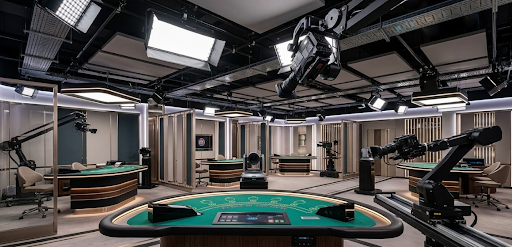
Live casino games are produced in dedicated studios that are built specifically for streaming. These are not repurposed film sets or improvised spaces. They are purpose-engineered environments designed around camera placement, lighting, acoustics, and network infrastructure. A single studio can run dozens of simultaneous game tables, each with its own camera rig, dealer, and production feed.
The physical layout of each table is standardised to match the digital interface players see on screen. Every card position, chip zone, and betting area on the real table corresponds to a clickable area in the player’s browser. The two layers , physical and digital , have to align precisely because bets placed on screen need to map accurately to what is happening on the actual table.
Lighting in these studios is calibrated to eliminate shadow and glare on card faces, dice, and roulette numbers. Camera systems use multiple angles simultaneously , overhead shots for the full table view, close-up cameras for card reveals, and wide shots to capture the dealer. A live roulette table typically has at least three camera angles running at the same time, and the player can often switch between them.
How the Video Stream Gets to Your Screen?
The video feed from a live casino studio travels through a series of encoding and compression stages before it reaches your browser. The raw footage from studio cameras is captured at high resolution , most modern live casino productions shoot in HD or 4K , then compressed into a format that can be delivered over standard internet connections without buffering.
This encoding happens in real time at the studio end. Specialised hardware encoders convert the live video feed into a streaming protocol that players receive through their browser or app. The target latency , the gap between the physical action at the table and what you see on screen , is typically between one and three seconds. Any longer than that and the game becomes difficult to follow, particularly for fast-paced formats like speed baccarat or rapid roulette.
Your end of the connection matters too. A stable broadband connection handles live casino streaming without difficulty. Mobile data connections on 4G or 5G are generally sufficient as well, though high-definition streams consume more data than standard video. The platform side handles adaptive bitrate delivery, which automatically adjusts stream quality based on your connection speed to prevent interruption.
OCR Technology: How the Game Result Becomes Data
The most technically interesting part of live casino infrastructure is Optical Character Recognition, commonly referred to as OCR. This is the system that reads what is happening at the physical table and translates it into digital data that the software can process.

Every playing card in a live casino deck is printed with invisible sensor markings that OCR cameras can detect. When a dealer places a card on the table, the OCR system reads the card value instantly and registers it in the game software. The same process applies to roulette , when the ball settles into a numbered pocket, OCR cameras read the result and transmit it to the game interface within fractions of a second.
This matters because the digital game interface needs to know the result at the same moment the dealer reveals it. When you see the card values appear on your screen the instant the dealer turns them face up, that is OCR doing its job. The system also feeds the result into the game’s payout engine, which calculates wins and losses and updates player balances automatically.
The accuracy of OCR systems in modern live casino studios is extremely high. False reads , where the system misidentifies a card or number , are rare and are caught by secondary verification checks built into the software before any payout is processed.
RFID Chips and Physical Verification
In live casino games that involve chips , primarily live poker and some baccarat formats , RFID technology adds a second layer of physical verification on top of OCR. Each casino chip contains an embedded RFID tag that transmits a unique identifier when it passes over a reader embedded in the table surface.
When a dealer places chips into a betting zone or transfers them across the table, the RFID readers log every movement. This creates a complete record of all chip transactions at the table, which the platform can audit against the visual record from the cameras. The combination of OCR and RFID gives operators a dual verification trail that makes errors , and any attempt at manipulation , detectable.
From a player perspective, this infrastructure means the game result and the payout calculation are not relying on a single point of data capture. Multiple independent systems are recording the same event and cross-referencing each other before your balance is updated.
How Bets Are Placed and Locked?
The betting interface in a live casino game operates on a strict timer that runs in parallel with the physical game. When a new round begins, a betting window opens and you have a set number of seconds to place, adjust, or remove your bets. When that window closes, the software locks your bets and transmits them to the game server.
From that point, your bet is committed. The dealer then performs their physical action , dealing cards, spinning the wheel , and the OCR system reads the result. The game server compares the result against all locked bets, calculates payouts, and returns the outcome to every connected player simultaneously. The entire process from bet lock to payout calculation takes less than a second on the server side.
The betting interface itself is designed to prevent conflicts between what different players bet. Because live casino tables often have hundreds of players connected simultaneously , particularly on popular blackjack and roulette tables , the server handles bet processing in a queue to ensure every transaction is recorded accurately before results are applied.
The Dealer’s Role and Training
Live casino dealers are trained professionals, not actors. Their job combines the technical knowledge of a land-based casino dealer with the communication skills needed to perform on camera while managing a game. They handle all the physical game mechanics , shuffling, dealing, spinning, paying out , while also reading player chat messages and keeping the session moving at pace.

Dealers are trained to maintain a consistent tempo that keeps the game flowing without rushing players during the betting window. They also narrate actions as they perform them, which serves two purposes: it keeps players oriented within the game sequence, and it provides an audio track that production teams can use to verify the sequence of events in any disputed round.
The human element is precisely what makes live casino games different from RNG games at a mechanical level. Card shuffling, for instance, is performed either manually by the dealer or by an automated shuffling machine in view of the camera. Either way, the process is physically observable, which removes a category of doubt that exists with software-based shuffling.
RTP in Live Casino Games: Why It Works Differently
Return to Player , RTP , in a live casino game is a fixed mathematical property of the game rules themselves, not a configurable setting in the software. This is a meaningful distinction from slots, where the operator can select from multiple RTP versions of the same game title.
In live blackjack, the RTP is determined by the number of decks in use, the specific rule set applied , whether the dealer hits or stands on soft 17, whether doubling after splits is permitted, and so on. These rules are fixed for each table and visible to the player before they sit down. A standard six-deck blackjack game with favourable rules carries an RTP above 99% for a player using basic strategy.
This is why Moonbet live blackjack with near-perfect RTP is a mathematically significant offering. Several live blackjack titles on the platform reach 99.99% RTP , meaning the house retains less than 0.01% over time , which is only achievable because the game rules and the live dealer format combine to produce that outcome. No software adjustment is involved. The mathematics come from the rules of the game as dealt by a real dealer.
Live roulette RTP follows the same logic. European roulette , single zero , has a house edge of 2.7% and an RTP of 97.3%, regardless of whether you play at a physical casino table or a live streamed version. The wheel, the numbers, and the payout ratios are the same. The only thing that changes is the delivery mechanism.
What Happens When Something Goes Wrong?
Live casino games have contingency protocols for equipment failures, stream interruptions, and dealing errors. These protocols exist because the game involves real money and real-time action, and disputes need to be resolvable.
If the video stream drops on the player’s side, their locked bets remain active on the server. The round completes, the result is recorded, and when the connection restores the player’s balance is updated to reflect the outcome. They do not lose their bet because their screen went blank.
If the dealer makes a physical error , misreading a card, placing a chip incorrectly , the round can be voided. Both the camera feed and the OCR record provide evidence for the pit manager, who observes each table remotely and can intervene in a round in progress. In a voided round, all bets are returned to players and the round is replayed from the deal.
Every round in a live casino game is recorded in full , video, OCR data, bet records, and payout calculations , and retained for dispute resolution. If a player believes a payout was calculated incorrectly, the platform can pull the full audit trail for that specific round and verify every step.
Live Casino Games on Mobile
The architecture described above functions identically whether you access a live casino game on a desktop browser or a mobile device. The studio production, streaming, OCR systems, and bet processing are all server-side operations. Your device is only responsible for displaying the stream and transmitting your betting inputs.
Mobile interfaces for live casino games are adapted for smaller screens , the betting grid is simplified, camera angles are pre-selected rather than switchable, and the chat interface is condensed. The underlying game is the same. A live roulette spin seen on a 6-inch phone screen and a 27-inch monitor is the same physical spin, from the same studio, processed by the same OCR system.
The practical requirement on the player side is a stable connection. Mobile live casino streaming at standard definition uses roughly 300-500MB per hour. HD streaming uses approximately double that. On a reliable Wi-Fi or 4G connection, neither figure causes any issue for normal session lengths.
The Difference Between Live Casino and RNG Casino Games
The distinction between a live dealer game and an RNG-based table game is not cosmetic. They are different products at the infrastructure level.
An RNG blackjack game uses a certified random number generator to determine card sequences. The output is statistically random, independently audited, and perfectly fair , but the process is invisible to the player. You cannot watch the cards being shuffled. You take it on trust that the software is functioning as certified.
A live dealer blackjack game uses physical cards shuffled by a human dealer in a visible, recorded environment. The shuffle happens in front of the camera. The cards are physical objects dealt to a physical felt. The result is observable by every player connected to the table, and the OCR record provides a secondary verification layer.
Neither format is inherently more or less fair , both carry rigorous certification requirements. The difference is in the nature of the evidence. RNG games offer mathematical proof of fairness. Live casino games offer observable proof of fairness. For players who prefer to see the mechanics rather than rely on certification documents alone, live dealer games resolve that preference entirely.
The Bottom Line
Live casino games are a genuine hybrid of broadcast production, computer vision, real-time networking, and game mathematics. The studio provides the physical game environment. OCR and RFID systems read physical events and convert them to data. Streaming infrastructure delivers that data to thousands of simultaneous players. The game server processes bets, applies results, and settles payouts , all within seconds of the physical action taking place.
Understanding how that system works changes how you engage with the games. You know what the dealer is doing and why. You know how the result gets from the table to your screen. You know what happens if something breaks. None of that knowledge changes the house edge, but it removes the opacity that makes some players uncomfortable with online gambling in the first place.