Building one 3D asset is an art problem. Building a catalog is a production-design problem.
That distinction became much clearer to me after publishing dozens of stylized fantasy assets and growing the Knit of Shadows Fab catalog to 80 visible listings. The biggest lessons were not about making more geometry. They were about deciding what deserves to exist as a standalone product, what should become part of a pack, how much consistency matters across a series, and how to make the buyer understand an asset before they download anything.
For solo developers and small teams, these are the same problems that appear inside a game project. A marketplace catalog simply makes them easier to see because every weak decision becomes a product page.
1. A model is not automatically a product
The first trap is simple: you finish an asset, so you assume it should become a listing.
That works for a while because publishing feels like progress. But if every finished mesh becomes a separate product, the store slowly turns into a pile of unrelated objects.
A better test is to ask whether the asset has a clear job by itself.
A standalone asset usually makes sense when:
- its purpose is obvious without other pieces;
- it can work in several scenes or projects;
- its silhouette is distinct enough to justify its own page;
- a buyer could reasonably search for that object directly;
- it does not feel like one fragment of a larger construction.
A forge, throne, weapon rack, bookshelf, or ritual prop can often pass that test. A tiny decorative connector or one wall fragment usually cannot.
This is very similar to feature design in games. A feature should not exist only because it was possible to build. It should have a reason to be there.
2. Packs need a reason beyond quantity
The opposite mistake is padding a pack just to reach a larger number.
credit: Knit of Shadows / Sergey Baranenko
A pack is useful when the combination itself creates more value than the individual pieces. A blacksmith set becomes more useful when it covers the readable production loop around the space: forge, storage, tools, quenching, work surfaces, and display elements.
A modular building pack becomes useful when the parts can actually create several complete structures, not when it contains thirty variations that still leave the buyer missing essential pieces.
This changed how I think about scope. Instead of asking, “How many models should this pack contain?” I ask:
What scene, gameplay role, or production problem should the buyer be able to complete after downloading it?
That question is much harder to fake with filler.
A small coherent pack can be stronger than a larger unfocused one because the buyer can immediately imagine where it belongs.
3. Cohesion is a production rule, not a mood board
Visual consistency sounds obvious until you try to maintain it across dozens of objects.
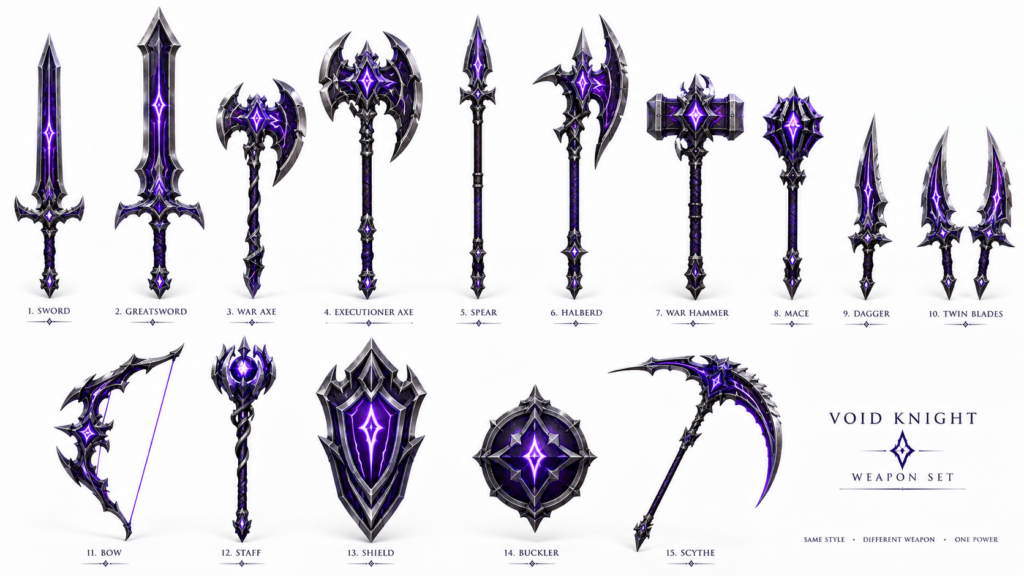
For a stylized fantasy series, I found that broad rules matter more than tiny ornamental details. Silhouette, proportion, material language, and detail density create the family resemblance.
For example, I can define a simple style language:
- broad, readable wood construction instead of noisy plank detail;
- dark iron or gunmetal with clean large forms;
- blocky stylized stone rather than realistic surface complexity;
- stronger magical accents only on important ritual or hero objects;
- large decorative shapes before micro-runes, bolts, and patterns.
Those rules are useful because they can be checked.
“Make it feel gothic” is subjective. “Keep the same broad board proportions, dark metal family, and accent hierarchy as the approved hero props” is actionable.
This also matters in game teams. Art direction becomes much easier to outsource when it is expressed as concrete constraints instead of adjectives.
4. Buyer clarity starts before the description

credit: Knit of Shadows / Sergey Baranenko
A buyer should understand the product from the title, first image, and first few seconds on the page.
That sounds like marketing advice, but it is also interface design.
A listing page has a user flow:
- The buyer sees a thumbnail.
- They read the title.
- They scan the first image.
- They check the price.
- They decide whether the object solves a problem they currently have.
- Only then do they read technical details.
If the product requires a paragraph of explanation before the buyer can tell what it is, something is already wrong.
This made me simplify titles and preview priorities. The first image should show the actual product clearly, not bury it inside a dramatic scene. Secondary images can provide scale, context, or alternate angles.
For tools and planning products, the same rule applies: show the real workbook, tracker, or output early. Do not make the buyer reverse-engineer what they are paying for from marketing copy.
5. Naming becomes infrastructure at scale
With a handful of assets, sloppy names are annoying. With dozens of products and source files, sloppy names become expensive.
A consistent naming convention helps with:
- searching source files;
- matching exports to product pages;
- keeping screenshots tied to the right asset;
- preventing accidental duplicate uploads;
- packaging customer files;
- tracking revisions;
- handing work to another person later.
The important lesson is that naming should identify the object, not preserve the history of every edit.
Names like FinalSword_v7_REAL_FINAL2 are not version control.
A stable product identity and a separate revision history are much safer. The same principle applies inside Unity or Unreal projects: runtime assets should have predictable names, while working versions belong in source control or production storage.
6. Technical truth matters more than impressive copy

credit: Knit of Shadows / Sergey Baranenko
Marketplace pages create pressure to make everything sound better than it is.
That is dangerous because technical uncertainty becomes support work later.
If an asset is one combined static mesh, say that. If collision is not included, do not imply that it is. If a product was only tested through a certain workflow, describe the workflow you actually tested instead of claiming universal compatibility.
For a solo seller, every unsupported promise becomes future debt.
The safest product description is not the most conservative-sounding one. It is the one that clearly separates verified facts from assumptions.
I now think of technical listing data as a small evidence record:
- what files are actually included;
- what was tested;
- what the buyer may need to configure;
- what is intentionally not included;
- what license or source information should be checked at the original platform.
That is also good production discipline for games. “Works in our test scene” and “works everywhere” are very different statements.
7. Free tools can expose the same production problems

credit: Knit of Shadows / Sergey Baranenko
After building the asset catalog, I started turning repeated production questions into small planning tools and checklists: asset budgeting, source/license records, QA gates, outsourcing handoff, naming conventions, launch planning, and similar workflows.
The interesting part is that the same design rules still apply.
A useful tool needs a narrow job.
A checklist should not try to become project-management software. A planner should not pretend to replace legal review. A QA tracker should help organize evidence, not claim that a green spreadsheet proves a game is bug-free.
The more specific the boundary, the easier the tool is to understand and use.
That mirrors the asset lesson exactly: a clear small product is often more useful than a vague large one.
8. Catalog growth should make decisions easier, not harder
More products are only useful if the catalog becomes easier to navigate as it grows.
Once a catalog becomes large enough, grouping matters more than raw count.
Related assets should form recognizable production clusters: workshop props, ritual furniture, weapons and equipment, modular building components, and so on.
The goal is to help a buyer move from one object to a usable scene or system.
That is the point where a catalog stops being a list of files and starts becoming a product architecture.
The same idea applies to a game project. Hundreds of tasks do not automatically mean progress. A good production structure helps the team understand how those tasks combine into complete player-facing outcomes.
The lesson I would keep
If I had to reduce the experience to one rule, it would be this:
Do not measure production by how many things you finished. Measure it by how many useful problems you closed clearly.
For a 3D marketplace, that means assets and packs with obvious roles, consistent visual language, truthful technical information, and clear buyer expectations.
For a game, it means features, content, and production systems that connect to a real player or team need.
Scale magnifies whatever rules you started with. If the rules are weak, eighty products create eighty places for confusion. If the rules are clear, the catalog becomes easier to build, explain, and extend.
That has been the most useful lesson from taking a solo asset workflow from individual models to a real catalog.
About the author
Sergey Baranenko is the solo creator behind Knit of Shadows, a stylized fantasy 3D asset catalog and a growing set of practical indie-game production tools. He works primarily with Blender and Unity-oriented workflows and writes about asset production, marketplace packaging, QA, and small-team game-development systems.
- Fab: https://www.fab.com/sellers/Knit%20of%20Shadows
- Knit of Shadows: https://knit-of-shadows-cloud.vercel.app/