AI 3D tools like Meshy can generate a textured base mesh from a sketch or prompt in under two minutes. As an AI 3D model maker, Meshy helps artists move from an initial idea to a workable starting point much faster than traditional manual modeling. That speed allows game teams to test five or even ten character or weapon variants before committing to one. The mesh still needs cleanup in Blender before it is ready for production.
How Does AI Speed Up Mobile Game Asset Prototyping?
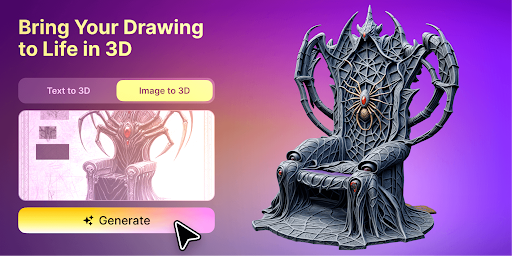
Speed is the whole pitch. Upload a sketch or type a prompt, and Meshy returns a fully textured 3D model in under two minutes. You don’t need modeling skills or software to do it.
That’s not a finished asset. It’s a starting shape your team can react to right away, instead of waiting two days to see if a character silhouette even works.
Why Do Props and Weapons Work Better Than Characters?
Weapons and props are rigid, single-material, and need no rigging. That’s why they come out closest to usable. A sword or a crate has one job: hold its shape.
Characters carry more risk. Asymmetry, clothes, and multiple limbs confuse the generation more often. You’ll regenerate more before one is worth keeping.
What Still Needs Fixing After the AI Generates Your Mesh?
The mesh isn’t done. It needs:
- Retopology to fix uneven, overly dense geometry
- UV cleanup before texture work holds up in-engine
- Normal map baking from the high-poly mesh onto a lighter game mesh
- A rig, if it’s a character
Does Blender Retopology Take Long?
Not as long as modeling from scratch, but it’s not instant either. Budget 20 to 40 minutes per character mesh using decimate and remesh tools, depending on complexity.
Why Does a Mobile Polygon Budget Decide If Your Prototype Runs Smoothly?
Mobile GPUs choke on mesh density that a PC handles fine. Meshy’s own engine guidance sets typical budgets at roughly 50,000 triangles for hero characters, 10,000 for NPCs, and 3,000 for props. Skip that step, and your prototype lags on anything but a flagship phone.
| Asset type | Typical raw AI output | Mobile-ready target |
| Hero character | 50,000+ triangles | ~50,000 triangles |
| NPC | 80,000+ triangles | ~10,000 triangles |
| Prop or weapon | 20,000+ triangles | ~3,000 triangles |
Where Does AI 3D Generation Break Down Today?
Modular environment kits. Generators output one-off objects with no grid awareness, so a generated wall section won’t snap to your level kit without manual edge work.
Organic texture seams are the other recurring problem, especially on creature heads. You’ll repaint those by hand more often than not.
How Did A Solo Developer Turn Sketches Into A Shipped Unreal Game?
Cristóbal Thompson, an architect-turned-solo-developer building the indie title Treasures of the Cajón, used Meshy’s Text to 3D and Image to 3D tools to generate assets such as cursed zombie miners and ceremonial relics directly from prompts and sketches, then imported the models into Unreal Engine for his atmospheric world. He says the workflow lets him focus on design and storytelling instead of getting stuck on modeling.
That’s the realistic win here. Not a finished game, but a solo developer competing visually without a modeling team behind him.
Does Auto-Rigging Really Replace Manual Rigging Work?
For standard humanoid proportions, mostly yes. For stylized characters with oversized heads or extra limbs, auto-rigging still misreads joints often enough that you’ll need manual correction.
5 Things To Check Before Importing Into Unity Or Unreal
- Export scale matches your project’s unit setup
- Material maps are assigned to the right shader slots
- Colliders are added, not assumed
- Poly count fits your device tier’s budget
- Rig bone names match your animation retargeting setup
Should You Trust AI-Generated Textures For Anything Beyond A Prototype?
No, and that’s fine at this stage. AI texture passes carry baked-in lighting and inconsistent material setups that fight your engine’s lighting later. They’re good enough to test color and mood, not to ship.
What Do Developers Who Tested This In Production Say?
Reviewer Mohab A. Karim, writing in May 2026 after testing Meshy’s full pipeline, gave an honest verdict. Asked whether the tool eliminated the need for traditional 3D artists, he concluded no, since a hero character built for an AAA cinematic still needs human precision. For background props and mid-distance NPCs, though, he found the output usable straight out of the browser.
That split is the honest read on where this fits. Hero assets stay manual. Everything around them speeds up.
Key Takeaways
- Weapons and props are the safest AI 3D win. Characters and modular environments still need the most manual rescue work.
- Mobile’s real bottleneck isn’t generation speed. It’s getting the mesh down to a 3,000 to 50,000 triangle budget before it ships.
Should You Build An AI 3D Step Into Your Mobile Pipeline?
If your team burns most of a sprint blocking out silhouettes before anyone plays the game, yes. Start with weapons and props; the cleanest AI 3D wins, then test characters once you trust your Blender cleanup pass. The mesh still needs human hands. It just stops needing them on day one.
If you’re still spending sprints blocking out silhouettes by hand, that’s the stage to compress. Bring your concept art into Meshy AI, get a base mesh in minutes, and put your Blender time where it counts: refinement, not creation from scratch.
FAQs
Can AI 3D tools replace a 3D artist on a mobile team?
No. Meshy AI and similar tools generate a starting mesh. Retopology, rigging, and final texture work still need a human artist before the asset ships.
How long does it take to get a usable prototype asset?
Generation itself takes under two minutes. Counting review and basic cleanup, a usable prototype mesh typically takes 30 minutes to a few hours.
What file formats does Meshy AI export?
Meshy supports FBX, OBJ, GLB, BLEND, USDZ, STL, and 3MF, all natively compatible with Unity, Unreal Engine, Godot, and Blender.
Are AI-generated characters rigged automatically?
Yes, for standard humanoid and quadruped proportions. Stylized or non-human characters often need manual rig correction afterward.
What asset type is the worst fit for AI 3D generation right now?
Modular environment pieces. They need to snap to a grid or tile correctly, and most AI tools generate them with no grid awareness.